In short
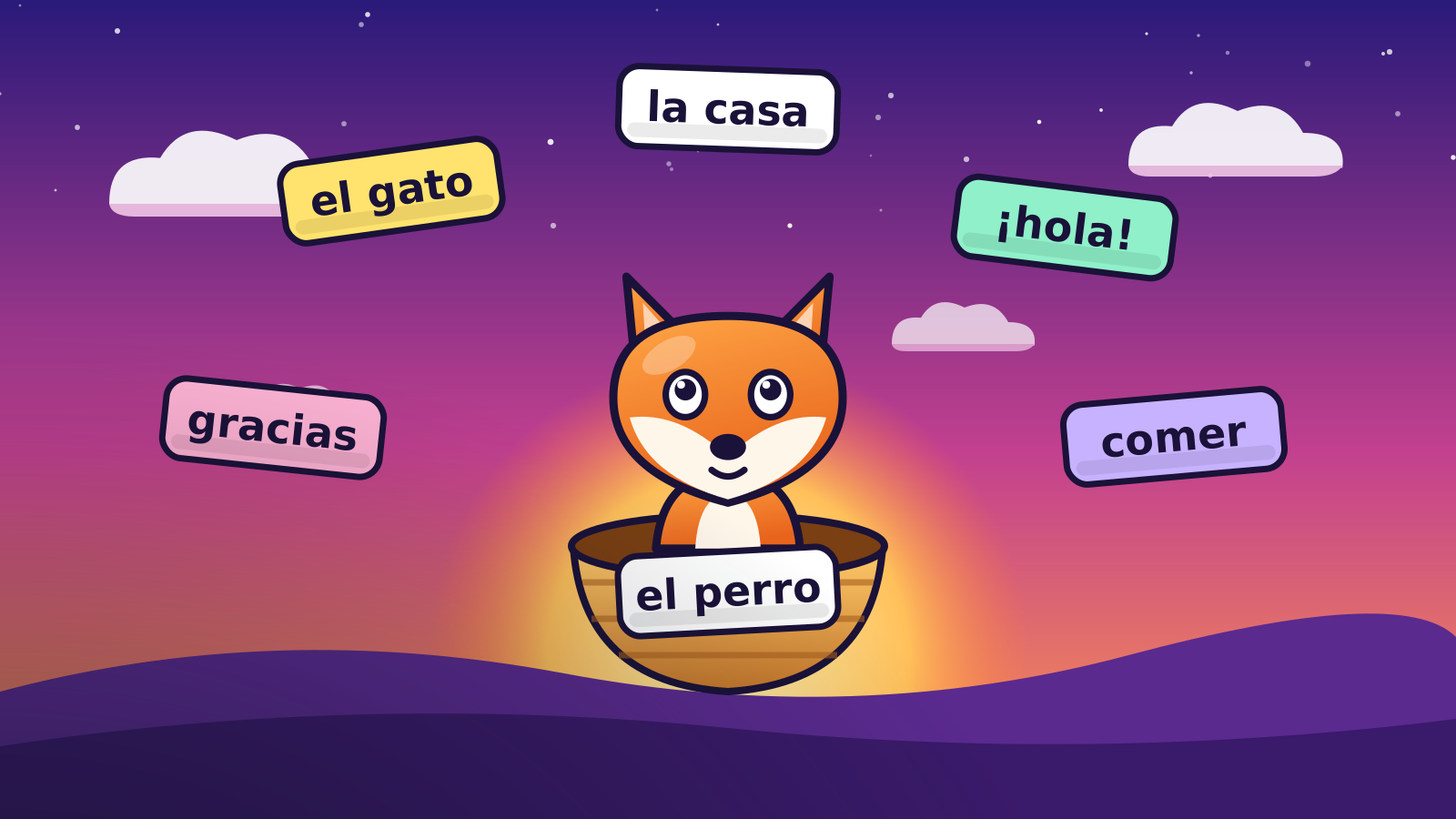
Word Catcher is a free Spanish vocabulary game for grades 3 to 7: an English word sits at the top of the screen and kids catch the falling Spanish word that means the same thing. Its three levels build from everyday nouns with el and la to action verbs and useful phrases like Tengo hambre.
Key facts
- La mano (the hand) is feminine even though it ends in -o. Source: SpanishDict: mano
- Agua is feminine, but it takes el (el agua) because it starts with a stressed a sound. Source: SpanishDict: agua
- Una biblioteca is a library; una librería is a bookstore, a common mix-up. Source: Word Catcher content file with a cited source for each word
- Tengo hambre means I'm hungry: in Spanish you "have" hunger. Source: Word Catcher content file with a cited source for each word
- Hace frío means it's cold, describing the weather. Source: SpanishDict: hace frío
In Word Catcher, an English word or phrase sits at the top of the screen and three Spanish ones fall from the sky. Your kid slides the fox's basket under the one that means the same thing and catches it. Six right catches clear a level, and every right catch speeds the words up a little.
A wrong catch, or letting the right word fall past, costs one of three hearts, and the game shows what the caught word really means next to the right answer. Three levels build up: everyday nouns with el and la, then action verbs, then useful phrases like Tengo hambre and ¿Cómo te llamas?
El and la
Every Spanish noun is masculine or feminine, and the word for "the" shows which: el for a masculine noun (el perro, el libro) and la for a feminine one (la casa, la manzana). Most nouns ending in -o are masculine and most ending in -a are feminine, but not all: la mano (the hand) is feminine. Agua is feminine too, yet it is el agua, because it starts with a stressed a sound. That is why the game always shows a noun with its article: the gender is learned with the word.
Look-alikes worth a second look
- Una biblioteca is a library; una librería is a bookstore.
- Hace frío means it's cold (the weather); tengo frío means I'm cold.
- Tengo hambre is I'm hungry; tengo sed is I'm thirsty.
- Buenos días is good morning; buenas tardes is good afternoon; buenas noches is good evening or good night.
- Hasta mañana is see you tomorrow; hasta luego is see you later.
Some of these fall right next to the answer in the game, so a quick glance isn't enough.
Having hunger and years
Where English says "I am", Spanish often says "I have" with tener: tengo hambre (I'm hungry, word for word "I have hunger") and tengo doce años (I'm twelve, "I have twelve years"). For the weather it uses hacer, "to make": hace frío, hace sol. Level 3 mixes these, so the English and the Spanish don't line up word for word.
Questions parents ask
What does the game cover?
Three levels: everyday nouns with el and la (grades 3 to 5), action verbs like comer, escribir and aprender (grades 4 to 6), and useful phrases like Muchas gracias, Tengo hambre and ¿Dónde está la biblioteca? (grades 5 to 7).
Is there a French version?
Yes. Word Catcher: French works the same way, with its own nouns, verbs and phrases.
Is the game free?
Yes. Word Catcher plays in a web browser with no account, no download and no ads, with a keyboard, a touch screen or the on-screen buttons.
Keep exploring
Sources
Every fact on this page was checked against these sources by a separate fact-checker on October 30, 2026. How we check facts.