In short
Timeline Rush is a free history timeline game for grades 5 to 8: kids slide an event into the right gap on a timeline, earlier or later than the events already there. Its three levels cover U.S. history from Jamestown (1607) to the Apollo 11 Moon landing (1969), the ancient world to the 1500s, and the modern world from 1789 to 1991.
Key facts
- BCE stands for Before Common Era and CE for Common Era; they number years the same way as BC and AD. Source: timeanddate.com: Common Era (CE) and Before Common Era (BCE)
- BCE years count down toward year 1, so 323 BCE came before 221 BCE. Source: Timeline Rush content file with a cited source for each event
- There is no year 0: the year after 1 BCE is 1 CE. Source: timeanddate.com: There was never a year zero
- In the C3 Framework for Social Studies, students in grades 3 to 5 create and use a chronological sequence of related events (D2.His.1.3-5). Source: C3 Framework for Social Studies State Standards (D2.His.1.3-5)
- Timeline Rush uses only events with well-settled dates, each with a cited source. Source: Timeline Rush content file with a cited source for each event
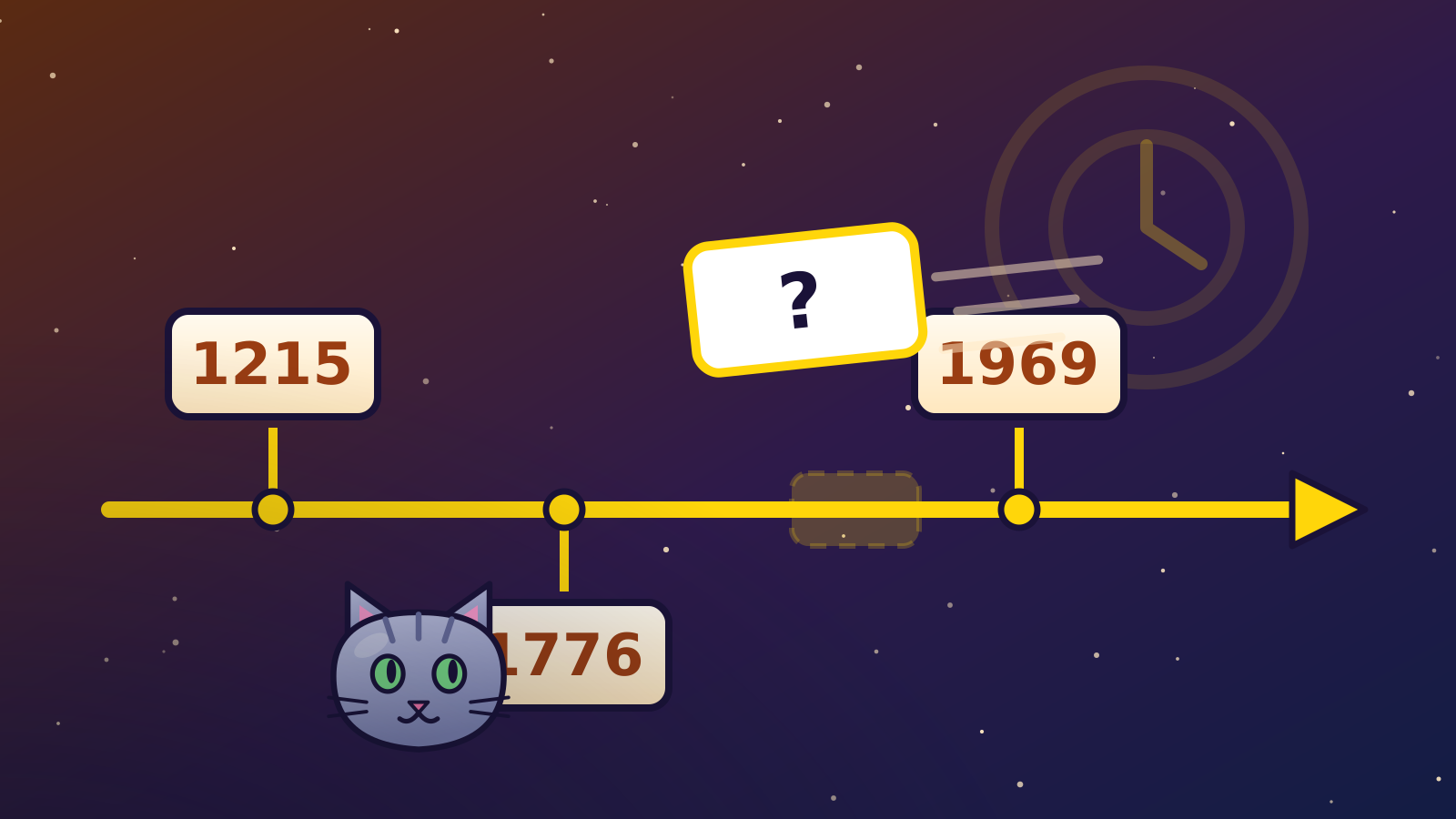
In Timeline Rush, an event from history waits beside a timeline that already shows two or three other events and their years. Your kid moves it into the right gap, earlier or later, before its timer runs out. A wrong spot costs a heart and shows the event's year and where it really goes.
What's in the game
- U.S. history (grades 5–6): 16 events, from the founding of Jamestown in 1607 to the Apollo 11 Moon landing in 1969.
- Ancient to 1500s (grades 6–7): 14 events, from the death of Alexander the Great in 323 BCE to the end of the first voyage around the world in 1522.
- Modern world (grades 6–8): 15 events, from the storming of the Bastille in 1789 to the breakup of the Soviet Union in 1991.
Every event has a cited source and was checked by a separate fact-checker. We chose events with well-settled dates and kept the events on each timeline years apart, so a right answer is always clearly right. Where a date is a convention, like 476 for the end of the Western Roman Empire, the explanation says so.
Reading BCE and CE dates
BCE stands for Before Common Era and CE for Common Era. They number the years the same way as BC and AD.
BCE years count down toward year 1, so 323 BCE came before 221 BCE, and 44 BCE came after both. There is no year 0: the year after 1 BCE is 1 CE.
Try it at home
Write five events from your own family on cards, like birthdays, moves or a first day of school, without the years. Put them in order together, then check. Afterwards, play a round of Timeline Rush: six right answers clear a level.
Questions parents ask
What grade learns about timelines?
In the C3 Framework for Social Studies State Standards, students in grades 3 to 5 create and use a chronological sequence of related events. Timeline Rush's three levels are aimed at grades 5 to 8.
Is the game free?
Yes. Timeline Rush plays in a web browser with no account, no download and no ads.
Does it work on a phone or a classroom projector?
Yes. It works with a keyboard, a touch screen or the on-screen buttons, and teachers can put it on a projector with no student accounts.
Keep exploring
Sources
Every fact on this page was checked against these sources by a separate fact-checker on October 30, 2026. How we check facts.