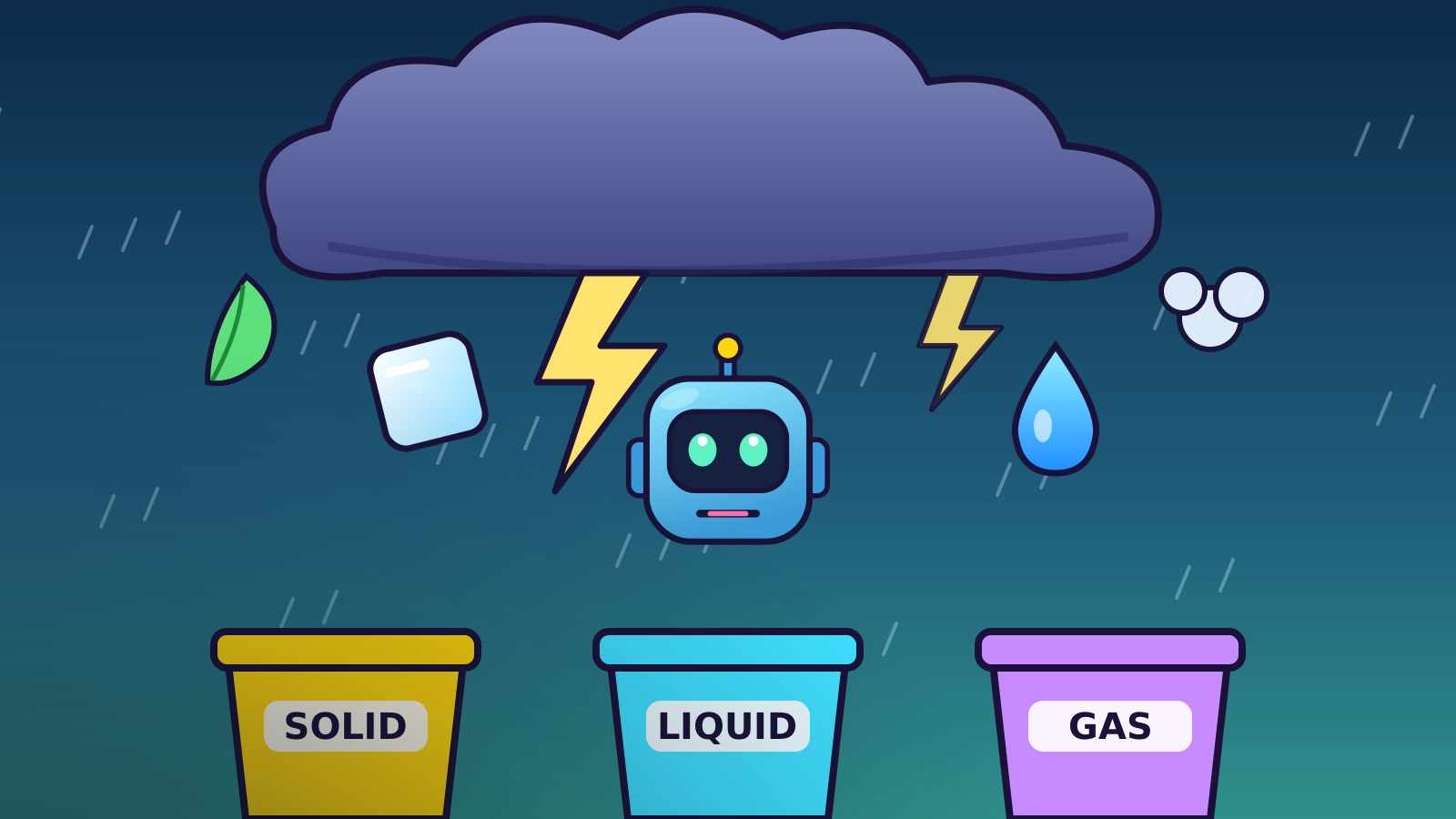
In Sort Storm, everyday things tumble out of a storm cloud: a pebble, a jar of honey, a balloon full of helium. Your kid steers each one into the right bin (solid, liquid or gas) before it lands. A wrong bin shows the right answer and why.
Solids, liquids and gases in one minute
- A solid keeps its own shape and size. Its particles are packed tightly and only jiggle in place. Examples: an iron nail, a pebble, an ice cube.
- A liquid has a fixed amount (volume) but takes the shape of its container. Its particles are close together but can slide past each other. Examples: milk, honey, olive oil.
- A gas spreads out to fill whatever container it is in, so it has no fixed shape or volume. Its particles are far apart and move quickly. Examples: helium in a balloon, the air in a bike tire, water vapor.
Water is the easiest example of all three: ice is solid, water is liquid and water vapor is a gas. Heating and cooling move a substance between states, which is a physical change, not a new substance.
Scientists also describe a fourth state, plasma: a gas given so much energy (for example by great heat or electricity) that electrons break away from its atoms, leaving electrically charged particles. Lightning and the Sun are examples of plasma.
Try it at home
Put an ice cube on a plate and check it every ten minutes: solid to liquid. Then ask where a puddle goes on a sunny day: liquid to gas. Afterwards, play a round of Sort Storm: six right answers clear the level, drawn from 18 everyday things.
Play the states of matter game
Questions parents ask
What grade learns states of matter?
In the Next Generation Science Standards, students describe and classify materials by their properties in grade 2, and in grade 5 they model matter as particles too small to be seen. Sort Storm's states of matter level is aimed at grades 4 and 5.
Is the game free?
Yes. Sort Storm plays in a web browser with no account, no download and no ads.
What else does Sort Storm teach?
Its next levels sort living things into producers, consumers and decomposers, and changes into physical and chemical changes.
Keep exploring
Sources
Every fact on this page was checked against these sources by a separate fact-checker.