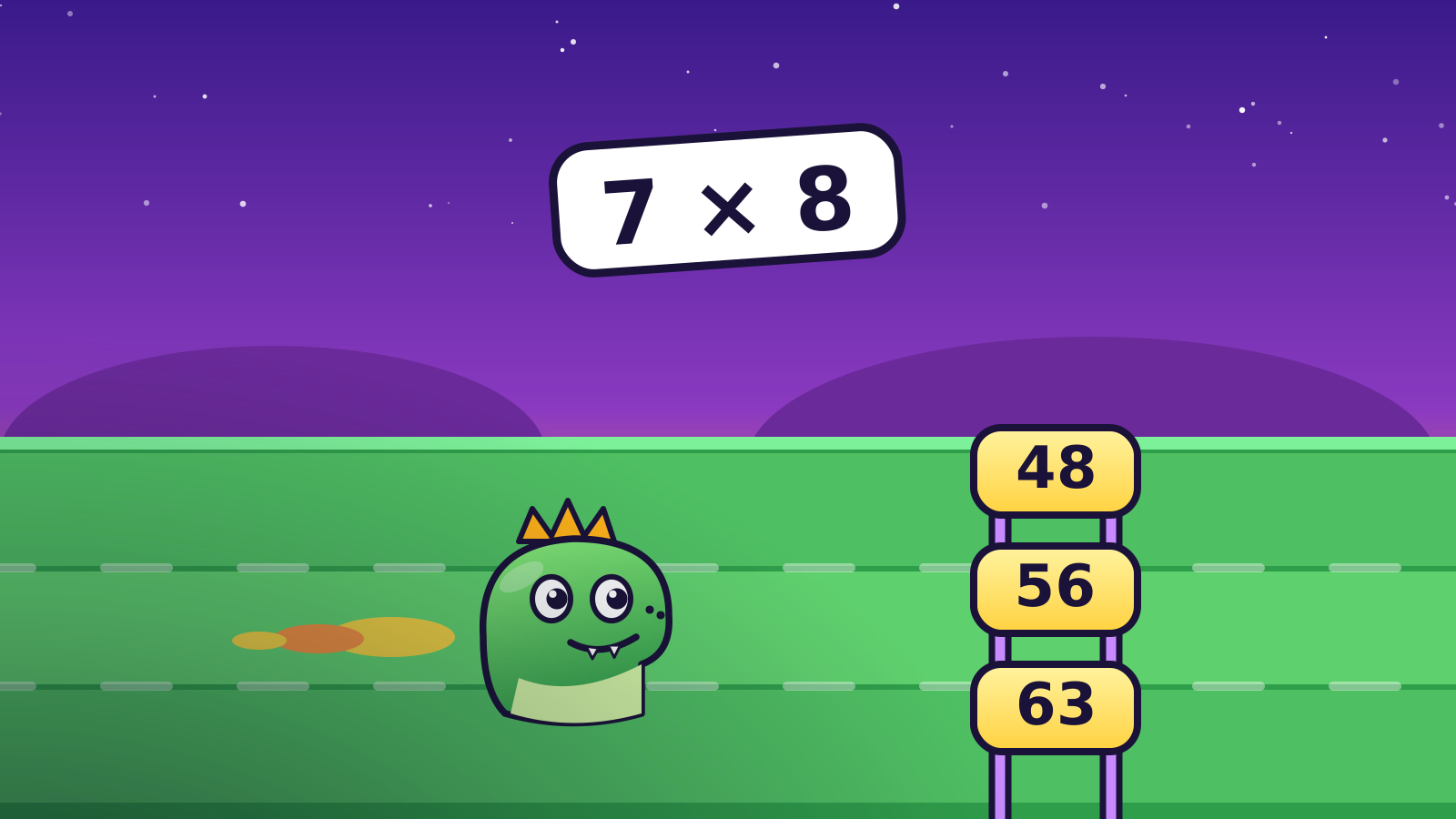
In Times Table Dash, a question like 7 × 8 appears and three answer gates race toward your dino. Steer into the right one to speed up; three in a row starts a turbo streak. A miss shows the right answer and a tip, and each level ends with a list of any facts that need more practice.
Three levels, from the clearest patterns to the trickiest facts
- Level 1: the 2, 5 and 10 times tables, where the patterns are easiest to see.
- Level 2: the 3, 4 and 6 times tables.
- Level 3: the 7, 8, 9, 11 and 12 times tables.
Each table runs from 1 to 12, and each question is shown one way round or the other at random (3 × 7 or 7 × 3), so kids practice both forms.
Why the order helps
Multiplication facts are easier when new ones are built from known ones. Times 4 is double times 2. Times 5 is half of times 10. And because 3 × 7 is the same as 7 × 3, every fact learned is really two.
The Common Core standards expect students to know from memory all products of two one-digit numbers by the end of grade 3. Short, frequent rounds are an easy way to keep the facts fresh.
Ready for more?
In Math-Man's Castle, kids race through a maze to grab the coin with the right answer, with levels for adding and subtracting, multiplying and dividing, and a mixed challenge.
Questions parents ask
What grade learns times tables?
In the Common Core standards, grade 2 builds toward multiplication with equal groups and arrays, and grade 3 expects students to know all products of two one-digit numbers from memory by the end of the year.
Is Times Table Dash free?
Yes. It plays in a web browser with no account, no download and no ads, on a laptop, tablet or classroom projector.
Does it have a timer?
No countdown clock. Each gate takes a few seconds to reach the dino, at a steady pace, and correct answers make the dino a little faster.
Keep exploring
- All about Times Table Dash
- Multiplication facts: an order that makes them easier to learn (and a free game to practice)
- 11 multiplication tricks that make times tables easier
- Flag quiz: guess the flag, then fly there
- States of matter game: solid, liquid or gas?
- Countries of the world quiz: find them on the map
Sources
Every fact on this page was checked against these sources by a separate fact-checker.