In short
Planet Hop is a free solar system game for grades 4 to 8: kids hop to the planet a question names, then move on to the Moon's phases and the layers of the Earth and its atmosphere. There are eight planets: Mercury, Venus, Earth, Mars, Jupiter, Saturn, Uranus and Neptune, in that order from the Sun.
Key facts
- Mercury is the closest planet to the Sun, but Venus is the hottest, because its thick atmosphere traps heat. Source: Planet Hop content file with a cited source for each item
- The Sun always lights half the Moon, and how much of that lit half we see changes as the Moon travels around Earth. Source: NASA: Moon Phases
- Earth's atmosphere has five layers, from the troposphere up to the exosphere. Source: NASA: Earth's Atmosphere, a Multi-Layered Cake
- Below Earth's crust and mantle, the core has two parts: the outer core and the inner core. Source: National Geographic Education: Core
- In the Next Generation Science Standards, middle schoolers use a model of the Earth-Sun-Moon system to describe the cycle of lunar phases, eclipses and seasons (MS-ESS1-1). Source: NGSS MS-ESS1-1
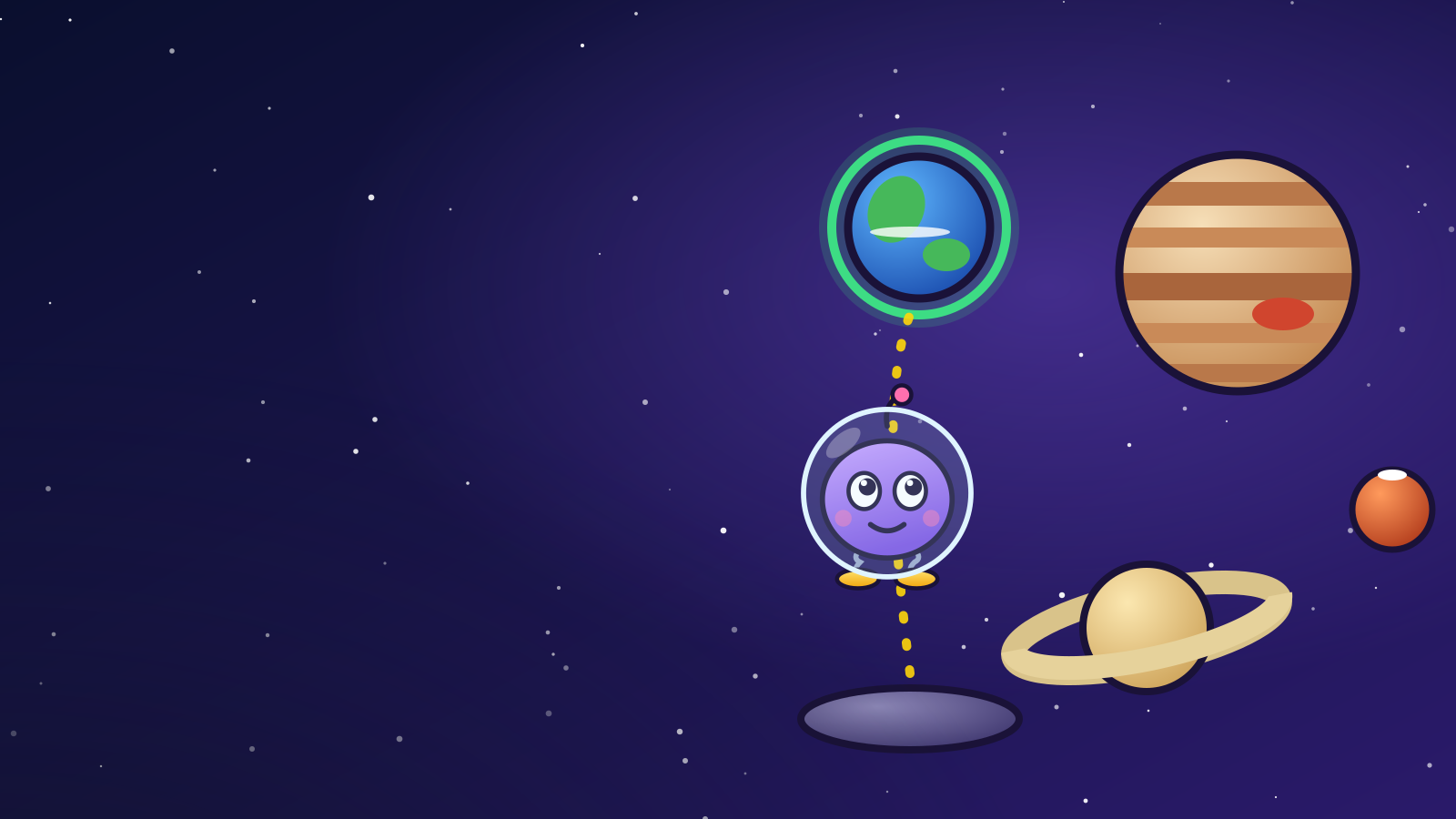
In Planet Hop, four stepping stones float in space, each holding a planet, and a question names one: the hottest planet, the one with the Great Red Spot, the third planet from the Sun. Your kid picks a stone and the little hopper jumps to it. Eight right hops clear a level.
A wrong hop bounces the hopper back, costs one of three hearts, and lights up the right stone with a sentence on why. The game waits until your kid is ready for the next question; there is no clock.
What each level covers
- Level 1, the planets (grades 4 to 6): the eight planets in order from the Sun, the rocky planets, gas giants and ice giants, and one stand-out fact about each, like Venus being the hottest planet and Neptune the windiest.
- Level 2, Moon phases (grades 5 to 7): the eight phases by picture and by name, their order, and why the Moon has phases at all.
- Level 3, layers of the Earth and air (grades 6 to 8): the crust, mantle, outer core and inner core, and the five layers of the atmosphere from the troposphere up to the exosphere.
Mix-ups worth a second look
Mercury is the closest planet to the Sun, but Venus is the hottest: its thick atmosphere traps heat.
The Moon's phases are not caused by Earth's shadow. The Sun always lights half the Moon, and as the Moon goes around Earth we see more or less of that lit half. Earth's shadow only falls on the Moon during a lunar eclipse.
Which side of the Moon looks lit depends on where you are. The game's Moon pictures show it as seen from the Northern Hemisphere, where a waxing Moon is lit on the right.
Questions parents ask
What grade learns about the Moon's phases?
Middle school. In the Next Generation Science Standards, students in grades 6 to 8 use a model of the Earth-Sun-Moon system to describe the cycle of lunar phases, eclipses and seasons (MS-ESS1-1). Planet Hop's Moon level is aimed at grades 5 to 7.
How many planets are there?
Eight: Mercury, Venus, Earth, Mars, Jupiter, Saturn, Uranus and Neptune, in that order from the Sun.
Is the game free?
Yes. Planet Hop plays in a web browser with no account, no download and no ads, with a keyboard, a touch screen or the on-screen buttons.
Keep exploring
Sources
Every fact on this page was checked against these sources by a separate fact-checker on October 30, 2026. How we check facts.