In short
The main parts of a cell are the nucleus, cell membrane, cytoplasm, mitochondria and ribosomes, and plant cells also have a cell wall, chloroplasts and a large central vacuole. In Cell Builder, a free game for grades 6 to 8, kids build a plant or animal cell by placing the part that does each job.
Key facts
- Mitochondria make ATP, the cell's main energy carrier, in both plant and animal cells. Source: OpenStax Biology 2e, 4.3 Eukaryotic Cells
- Chloroplasts use light energy to make sugar from carbon dioxide and water; plant cells have them and animal cells do not. Source: OpenStax Biology 2e, 4.3 Eukaryotic Cells
- Ribosomes build proteins. Source: OpenStax Biology 2e, 4.3 Eukaryotic Cells
- Bacteria are prokaryotes: they have no nucleus, and their DNA sits in a central region called the nucleoid. Source: OpenStax Biology 2e, 4.2 Prokaryotic Cells
- In the Next Generation Science Standards, middle schoolers model how the parts of a cell contribute to its function (MS-LS1-2). Source: NGSS MS-LS1-2
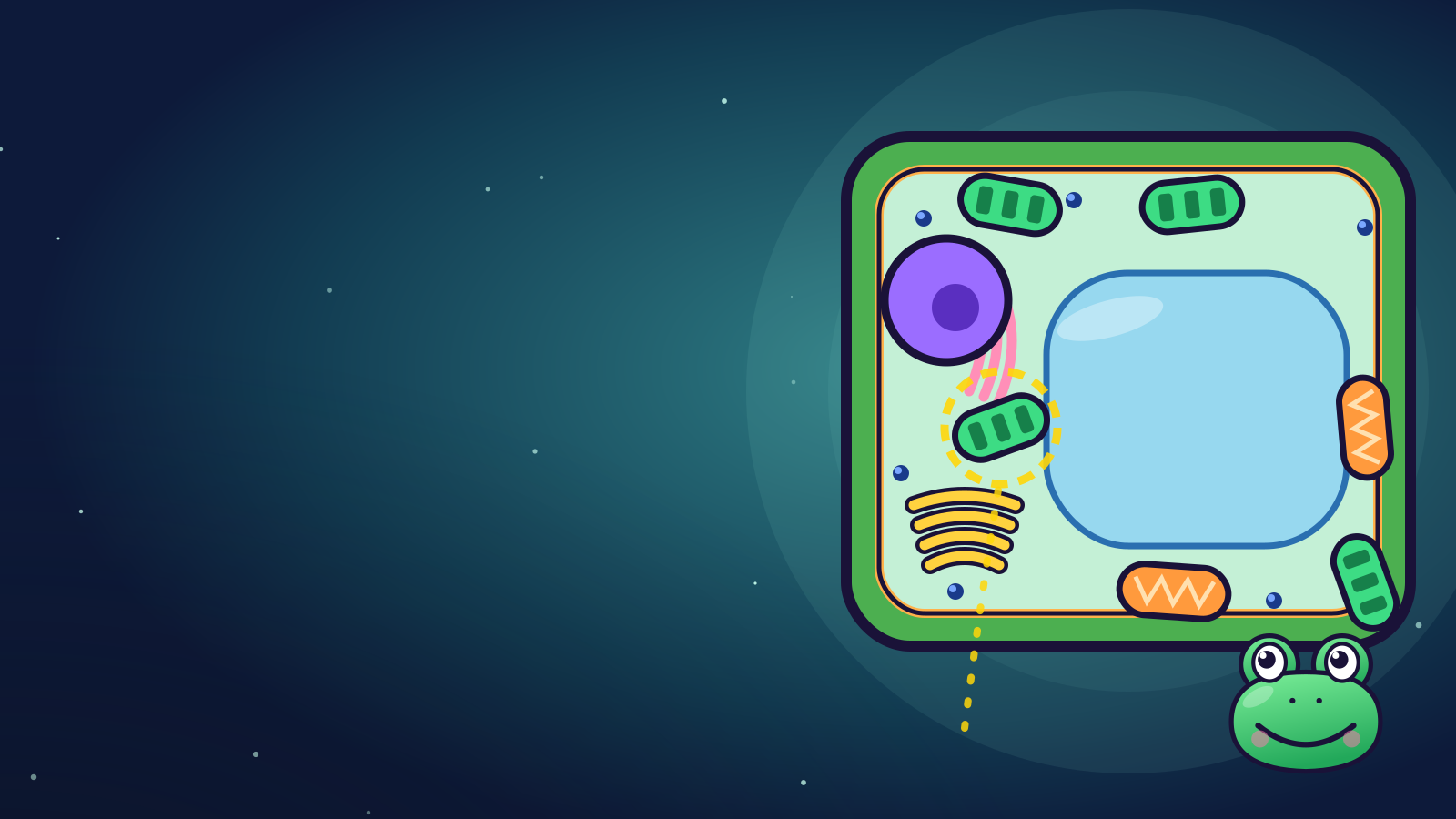
In Cell Builder, a plant cell or an animal cell sits under the microscope with four of its parts missing, and a glowing spot shows where the next one goes. The question names a job, like "builds proteins" or "uses light energy to make sugar", and your kid places the part that does it. Each right part grows into the cell until it is complete.
A wrong part costs a heart, and the game shows the right part in its place with a sentence on what it does. It waits until your kid is ready for the next one; there is no clock.
The parts and their jobs
- Nucleus: houses the cell's DNA and directs the making of proteins.
- Cell membrane: controls what passes into and out of the cell.
- Cytoplasm: fills the cell between the membrane and the nucleus.
- Mitochondria: make ATP, the cell's main energy carrier.
- Ribosomes: build proteins.
- Endoplasmic reticulum (ER): a network of membranes that changes new proteins and makes lipids.
- Golgi apparatus: sorts, tags and packages proteins and lipids, and sends them on.
- Chloroplasts (plants): use light energy to make sugar from carbon dioxide and water.
- Cell wall (plants): a stiff covering outside the membrane that protects and supports the cell.
- Central vacuole (plants): a large sac that holds water.
Plant cells, animal cells and bacteria
Plant cells have a cell wall, chloroplasts and a large central vacuole, and animal cells do not. Both have a nucleus, a cell membrane, cytoplasm, ribosomes and mitochondria.
Bacteria are prokaryotes: they have no nucleus, and their DNA sits in the cytoplasm. Like every cell they have a cell membrane, cytoplasm, DNA and ribosomes, and they also have a cell wall. Level 2 of Cell Builder puts a leaf cell, an animal cell and a bacterium side by side, so your kid can look for these differences.
Mix-ups worth a second look
Plant cells have mitochondria too. Chloroplasts make sugar using light energy, and mitochondria make ATP for the cell to use, in plants and animals alike.
The cell wall and the cell membrane are not the same thing. A plant cell has both: the stiff wall on the outside, and the membrane just inside it controlling what passes in and out.
Questions parents ask
What grade learns the parts of a cell?
Middle school. In the Next Generation Science Standards, students in grades 6 to 8 model how the parts of a cell contribute to its function (MS-LS1-2), naming the nucleus, chloroplasts, mitochondria, cell membrane and cell wall. Cell Builder is aimed at grades 6 to 8.
Do plant cells have mitochondria?
Yes. Mitochondria are found in both plant and animal cells. Plant cells also have chloroplasts, which animal cells do not.
Is the game free?
Yes. Cell Builder plays in a web browser with no account, no download and no ads, with a keyboard, a touch screen or the on-screen buttons.
Keep exploring
Sources
Every fact on this page was checked against these sources by a separate fact-checker on October 30, 2026. How we check facts.