In short
The periodic table orders the elements by atomic number, the number of protons in an atom, and elements in the same column (group) tend to have similar chemical properties. Element Dash is a free game for grades 5 to 10 in which kids steer an owl through the gate with the right element, from symbols like O and C to atomic numbers, old symbols like Fe and Au, and element families.
Key facts
- An element's atomic number is the number of protons in its atoms: every carbon atom has 6 protons, and every oxygen atom has 8. Source: OpenStax Chemistry 2e: Atomic Structure and Symbolism
- The alkali metals are group 1 of the periodic table, apart from hydrogen, and the noble gases are group 18. Source: OpenStax Chemistry 2e: The Periodic Table
- Some symbols come from older Latin names: Fe from ferrum (iron), Au from aurum (gold) and Pb from plumbum (lead). Source: OpenStax Chemistry 2e: Atomic Structure and Symbolism
- Na for sodium comes from the Latin natrium, and K for potassium from kalium. Source: OpenStax Chemistry 2e: Atomic Structure and Symbolism
- In the Next Generation Science Standards, high school students use the periodic table as a model to predict the relative properties of elements (HS-PS1-1). Source: Next Generation Science Standards: HS-PS1-1 Matter and Its Interactions
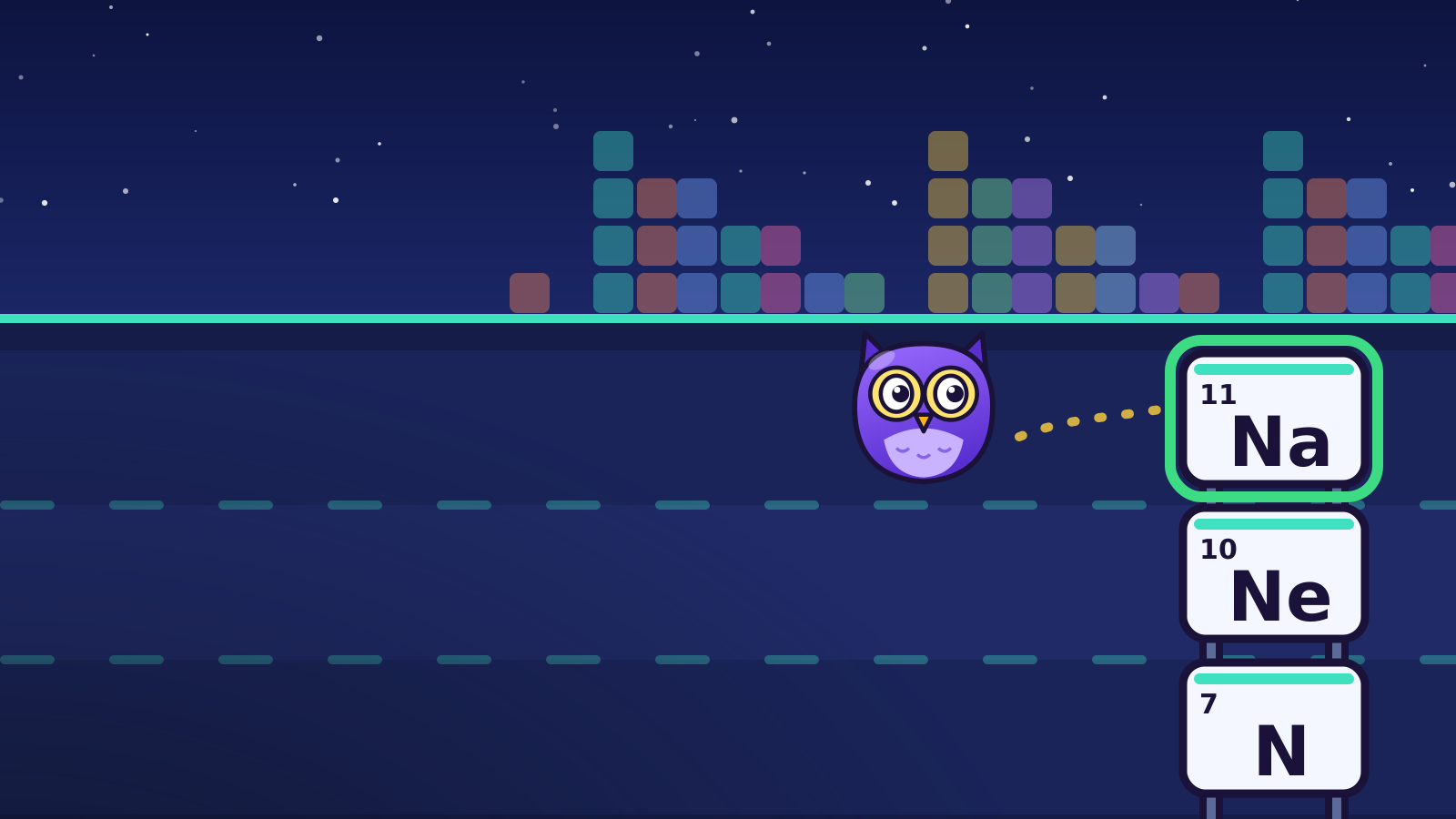
In Element Dash, an owl flies along three lanes while a question about the chemical elements sits at the top of the screen: which element is Na, what is the atomic number of magnesium, which of these is a noble gas. Three gates fly toward the owl, each with an answer, and your kid steers into the right one.
A right gate shows that element's square from the periodic table: its atomic number, symbol and name. A wrong gate costs a heart, and the game stops to show the right answer and why, for example that Na comes from the Latin natrium, or that the atomic number is the number of protons. It waits until your kid is ready for the next gate.
What's in the game
- Everyday elements (grades 5–6): symbols and names of 12 elements whose symbol starts like the name, such as H for hydrogen, O for oxygen, C for carbon and Ca for calcium.
- Metal or nonmetal? (grade 6): pick the metal, like iron, copper or gold, or the nonmetal, like oxygen, carbon or neon.
- The first 20 elements (grades 6–7): symbols and names from hydrogen (H) to calcium (Ca), both ways round. The wrong gates are look-alikes where the first 20 elements have them, like S and Si when the question is sodium.
- Atomic numbers and old symbols (grades 8–10): the atomic number of each of the first 20 elements, which element has a given number of protons, and nine symbols that come from older names, like Fe for iron, Au for gold and Pb for lead.
- Element families (grades 9–10): alkali metals, alkaline earth metals, halogens and noble gases, which element is in the same family as another, and which elements are metals and which are nonmetals.
Every question is built from one table of 36 elements, taken from PubChem's periodic table, and the game checks that exactly one of the three gates fits before it shows a round. A separate fact-checker verified every element, every explanation and the code that writes them.
Why symbols, numbers and families?
The periodic table puts the elements in order by the number of protons in an atom, and that number is the element's atomic number: every carbon atom has 6 protons, every oxygen atom has 8. Elements in the same column, called a group, tend to have similar chemical properties, and some groups have family names, such as the alkali metals (group 1, apart from hydrogen) and the noble gases (group 18).
The Next Generation Science Standards use the periodic table in high school (HS-PS1-1): students use it as a model to predict the relative properties of elements, based on the patterns of electrons in the outermost energy level of atoms. Knowing the symbols, the atomic numbers and the families by heart makes that work much easier, and a fast game is a good way to practice them.
Try it at home
Look at food and medicine labels together and find element names: sodium, potassium, calcium, iron, zinc. Ask your kid for each symbol, and point out the odd ones, Na for sodium and K for potassium, which come from the Latin natrium and kalium. Then play a level of Element Dash.
Questions parents ask
What grade learns the periodic table?
In the Next Generation Science Standards, middle school students develop models to describe the atomic composition of simple molecules and extended structures (MS-PS1-1), and high school students use the periodic table as a model to predict the relative properties of elements (HS-PS1-1). Element Dash starts younger: its first two levels, everyday elements and metals or nonmetals, are for grades 5 and 6, and its last two, atomic numbers and families, for grades 8 to 10.
Why are some symbols so different from the names?
Some symbols come from older names for the element. Fe comes from the Latin ferrum (iron), Au from aurum (gold), Ag from argentum (silver), Pb from plumbum (lead), Sn from stannum (tin) and Cu from cuprum (copper). Na comes from natrium (sodium), K from kalium (potassium), and Hg from hydrargyrum, meaning liquid silver (mercury).
Is the game free, and does it work on a phone?
Yes. Element Dash plays in a web browser with no account, no download and no ads, with a keyboard, a touch screen or the on-screen buttons. Teachers can put it on a classroom projector with no student accounts.
Keep exploring
Sources
Every fact on this page was checked against these sources by a separate fact-checker on October 30, 2026. How we check facts.
- Element Dash content file with every element and explanation, and their sources
- PubChem: Periodic Table of Elements (data)
- OpenStax Chemistry 2e: Atomic Structure and Symbolism
- OpenStax Chemistry 2e: The Periodic Table
- Next Generation Science Standards: HS-PS1-1 Matter and Its Interactions
- Next Generation Science Standards: MS-PS1-1 Matter and Its Interactions
- PubChem element pages (history of each name and symbol), for example iron