In short
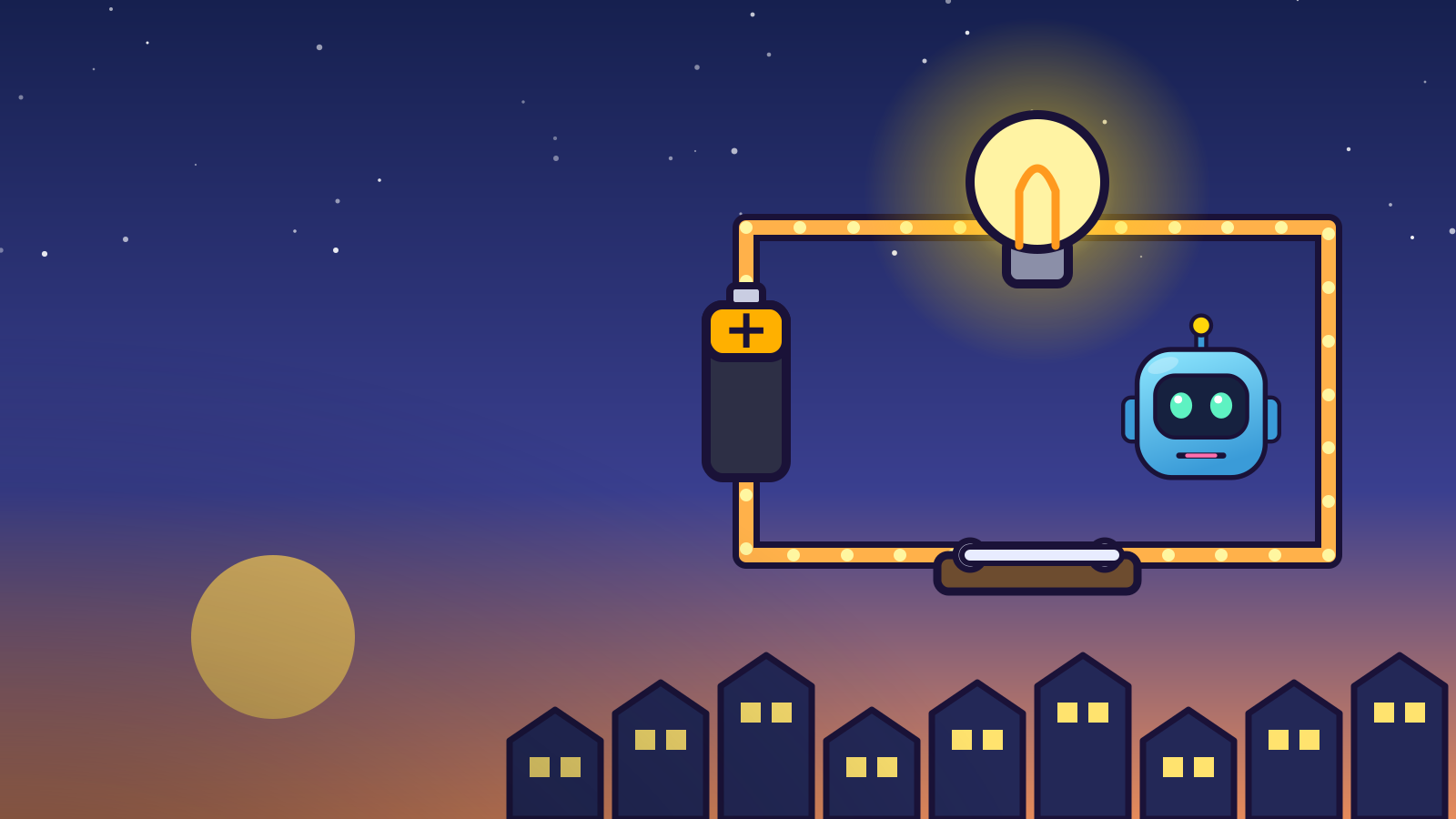
A bulb lights only when it is part of a complete loop from one end of the battery to the other. In Circuit Sprint, a free game for grades 3 to 8, kids finish circuits with the right part, place switches in series and parallel circuits, and spot a short circuit, and each wrong choice shows what it really does.
Key facts
- A circuit needs a complete loop for current to flow. Source: The Physics Classroom: Requirements of a Circuit
- In a series circuit the parts are joined in a single loop, so if one bulb is unscrewed the others go out too. Source: The Physics Classroom: Two Types of Connections
- In a parallel circuit each bulb has its own branch to the battery, so the others stay lit if one goes out. Source: The Physics Classroom: Two Types of Connections
- In the Next Generation Science Standards, fourth graders gather evidence that energy can be moved from place to place by electric currents (4-PS3-2). Source: Next Generation Science Standards: 4-PS3-2 Energy
- In England's national curriculum, Year 4 pupils build simple series circuits and recognize common conductors and insulators. Source: National curriculum in England: science programmes of study
In Circuit Sprint, your kid has until sunset to get a little town's power on, one circuit at a time. Each round asks for one thing: a part for a gap, a spot for a switch or a wire, or which of two circuits does what the goal says. Get it right and another house in the town gets its power; get it wrong and the circuit fizzles, a heart is lost, and the game shows what that choice did and why the right one works.
Wrong choices aren't just marked wrong: the circuit shows what they actually do. Put an open switch in the gap and the bulb stays dark. Put a wire across the battery and every bulb goes out.
What's in the game
- Light it up (grades 3–5): conductors and insulators (copper, aluminum, steel and iron against plastic, rubber, wood, glass and cotton), why a circuit needs a battery, open and closed switches, and which part gives light, sound or motion.
- Series and parallel (grades 5–7): where to put a switch in a parallel circuit to turn off every bulb or just one, and what happens to the other bulb when one is unscrewed in each kind of circuit.
- Fix it (grades 6–8): get a broken series circuit working again with a wire around the broken bulb, turn off one bulb with a wire across it, and find the short circuit.
Every round is built fresh, and the game works out the right answer with a circuit solver instead of a typed-in answer key. A separate fact-checker verified the rules and each explanation against the sources listed in the game's content file.
What kids learn
A bulb only lights when it is part of a complete loop from one end of the battery to the other. Metals are good conductors that let current through; plastic, rubber, wood and glass are insulators that block it. A switch opens and closes the loop.
In a series circuit the parts are joined in a single loop, so breaking it anywhere stops everything. In a parallel circuit each bulb has its own branch to the battery, so one can go out while the others stay lit. A bare wire is such an easy path that current takes it instead of going through a bulb; a wire straight across a battery is a short circuit.
Try it at home
With an adult, take one ordinary 1.5-volt AA, C or D battery (not a button or lithium cell), a small bulb in a holder made for that voltage, and a few wires with clips, and make a loop that lights the bulb. Then leave a gap and test things from around the house: a paper clip, a coin, a rubber band, a plastic spoon, a piece of string. Sort them into the ones that light the bulb and the ones that don't. Never connect the two ends of the battery with just a wire, and never experiment with wall outlets.
Questions parents ask
What grade learns about electric circuits?
In the Next Generation Science Standards, fourth graders gather evidence that energy can be moved from place to place by electric currents (4-PS3-2). In England's national curriculum, Year 4 pupils (ages 8 to 9) build simple series circuits, learn that a switch opens and closes a circuit, and recognize common conductors and insulators; series and parallel circuits come in key stage 3 (ages 11 to 14).
What is the difference between a series and a parallel circuit?
In a series circuit the parts are joined one after another in a single loop, so if one bulb is unscrewed the others go out too. In a parallel circuit each bulb sits on its own branch to the battery, so the others stay lit.
Is the game free, and does it work on a phone?
Yes. Circuit Sprint plays in a web browser with no account, no download and no ads, with a keyboard, a touch screen or the on-screen buttons. Teachers can put it on a classroom projector with no student accounts.
Keep exploring
Sources
Every fact on this page was checked against these sources by a separate fact-checker on October 30, 2026. How we check facts.
- Circuit Sprint content file with each round's rule and its source
- Next Generation Science Standards: 4-PS3-2 Energy
- National curriculum in England: science programmes of study
- GOV.UK: The national curriculum (key stages and ages)
- The Physics Classroom: Requirements of a Circuit
- The Physics Classroom: Series Circuits
- The Physics Classroom: Parallel Circuits
- The Physics Classroom: Two Types of Connections