In short
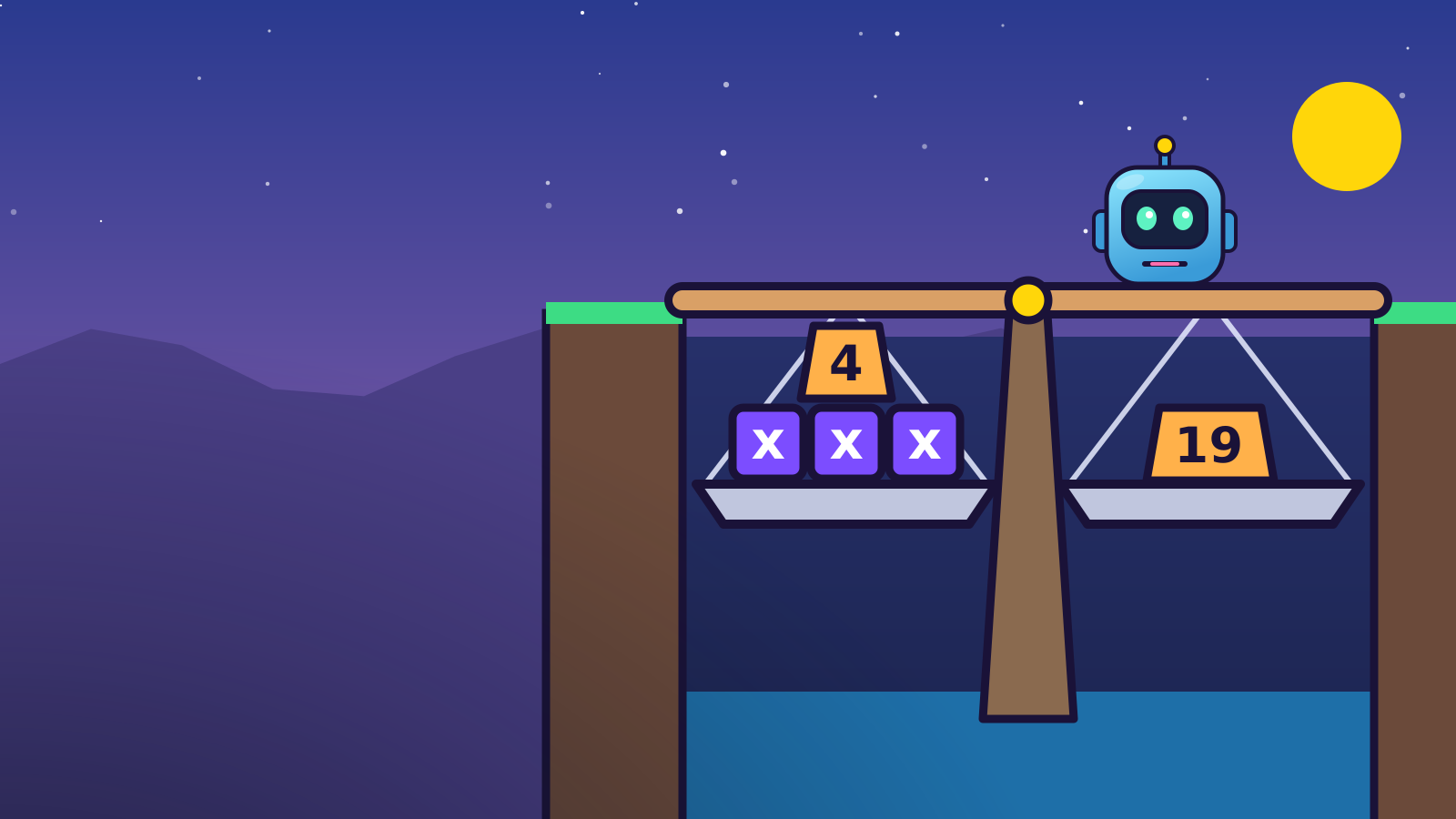
Solving an equation means finding the value of x that makes both sides equal, and Balance Bridge shows it as a balance that stays level only when they are. In this free game for grades 6 to 9, kids pick the weight for x, from one-step equations to two-step equations and variables on both sides.
Key facts
- The Common Core describes solving an equation in grade 6 as finding which values, if any, make the equation true (6.EE.B.5). Source: Common Core State Standards: Grade 6 Expressions and Equations
- Sixth graders solve one-step equations of the form x + p = q and px = q (6.EE.B.7). Source: Common Core State Standards: Grade 6 Expressions and Equations
- Seventh graders solve equations of the form px + q = r and p(x + q) = r (7.EE.B.4a). Source: Common Core State Standards: Grade 7 Expressions and Equations
- Eighth graders solve linear equations in one variable, including ones that need the distributive property and collecting like terms (8.EE.C.7b). Source: Common Core State Standards: Grade 8 Expressions and Equations
In Balance Bridge, the bridge over a river is a balance. An equation such as 3x + 4 = 19 hangs in its two pans: each x is a box and each number is a weight. Your kid picks one of four weights to put in every box. If both pans then weigh the same, the bridge stays level and a robot rolls across. If not, the bridge tips toward the heavier pan, both pans show their totals, and a short explanation walks through the steps.
Each wrong weight is a real number to try, so a wrong pick shows exactly why it doesn't work: with x = 6, 3 × 6 + 4 = 22, not 19.
What's in the game
- One-step equations (grade 6): x + 7 = 12, 15 = x + 9, 4x = 28, and the same with halves, like x + 2.5 = 7.
- Two-step equations (grade 7): 3x + 4 = 19, 26 = 4x + 2, and bags of x + 2, written 3(x + 2) = 21.
- Boxes on both sides (grades 8–9): 5x + 3 = 2x + 18, brackets on one side like 3(x + 2) = x + 14, and like terms to collect, like x + 4 + 2x = x + 16.
Every equation is generated fresh from rules that a separate fact-checker verified, and the game checks that exactly one of the four weights balances before it shows a round. Up to two of the wrong weights come from common slips, such as adding a number instead of taking it away, or forgetting the boxes on the other side; the others are close to the answer.
Why a balance?
An equation says two amounts are equal, and a balance shows that: the pans are level only when both sides weigh the same. Taking the same weight off both pans, or sharing both pans into the same number of equal parts, keeps them level, and those are the steps used to solve an equation.
The Common Core standards describe solving an equation in grade 6 as answering a question: which values from a specified set, if any, make the equation true? Students check a number by substituting it, which is what every weight in the game does. Grade 6 covers equations like x + p = q and px = q, grade 7 adds px + q = r and p(x + q) = r, and grade 8 adds equations that need the distributive property and collecting like terms.
Try it at home
Write an equation like 2x + 3 = 11 and ask your kid to guess x, then check the guess by putting it in: 2 × 5 + 3 = 13, too heavy; 2 × 4 + 3 = 11, balanced. Then ask what you could take off both sides first to make it quicker. Play a level of Balance Bridge and talk through one of the explanations together.
Questions parents ask
What grade learns to solve equations?
In the Common Core standards, sixth graders solve one-step equations of the form x + p = q and px = q (6.EE.B.7). Seventh graders solve equations of the form px + q = r and p(x + q) = r (7.EE.B.4a). Eighth graders solve linear equations in one variable, including ones that need the distributive property and collecting like terms (8.EE.C.7b), and high school algebra continues with linear equations in one variable (A-REI.B.3).
Does the game use negative numbers?
No. Every weight in a pan has to be positive, so every number in the game is positive and every answer is a whole number or a half. That keeps the focus on the steps of solving.
Is the game free, and does it work on a phone?
Yes. Balance Bridge plays in a web browser with no account, no download and no ads, with a keyboard, a touch screen or the on-screen buttons. Teachers can put it on a classroom projector with no student accounts.
Keep exploring
Sources
Every fact on this page was checked against these sources by a separate fact-checker on October 30, 2026. How we check facts.
- Balance Bridge content file with each equation rule and its source
- Common Core State Standards: Grade 6 Expressions and Equations
- Common Core State Standards: Grade 7 Expressions and Equations
- Common Core State Standards: Grade 8 Expressions and Equations
- Common Core State Standards: High School Reasoning with Equations and Inequalities