This worksheet practices one idea: a fraction is a number with its own place on the number line, just like 1 or 2. Page 1 shows eight number lines, each with a dot on one of the tick marks. Your child writes the number the dot stands for. Page 2 turns it around: each of the six lines names a number, and your child draws a dot where it belongs. The answer key on the last page gives every answer with a one-line explanation of how to count to it.
The problems get harder in the same order as the Number Line Bounce game. They start with fractions between 0 and 1 (Level 1 of the game, grades 3–4), then go past 1 to fractions greater than 1, mixed numbers and decimals (Level 2, grades 4–5). In the Common Core standards, grade 3 students learn to place fractions on a number line diagram (3.NF.A.2). In grade 4 they work with mixed numbers (4.NF.B.3) and write tenths and hundredths as decimals (4.NF.C.6).
Play the matching game
Number Line Bounce practices the same fractions and number line in a free browser game with no account and no ads.
Play Number Line BounceThe one rule that solves every line
Before your child writes anything, ask two questions about each line: How many equal parts is each whole cut into? And how many of those parts is the dot from 0? The first answer is the bottom number of the fraction, and the second is the top number. Point C, for example, sits on a line from 0 to 1 cut into 5 parts, 3 parts from 0, so it is 3/5.
The most common mistake is counting the tick marks instead of the spaces between them. A line from 0 to 1 cut into fourths has 5 tick marks, counting the ones at 0 and 1, but only 4 parts. If your child writes 1/5 for point A, have them put a finger on 0 and hop along the spaces, saying 'one fourth, two fourths…' as they go.
What each part practices
- Points A and B: unit fractions, the first part from 0.
- Points C and D: fractions like 3/5, which are several of those parts.
- Point E: equivalent fractions. The line is cut into eighths, but the dot also sits exactly on 3/4. Both 6/8 and 3/4 are right, and the key shows why.
- Points F and G: going past 1. 3/3 lands right on 1, and 7/4 lands three fourths past 1, so it is also 1 3/4.
- Point H: decimals. The line is cut into tenths, so the dot is 1.3, which is also 13/10.
- Page 2: the same ideas in reverse. Marking 2/3 on a line cut into sixths is the hardest one. It needs the same idea as point E.
If your child gets stuck
Go back to a paper strip. Cut a long strip of paper, write 0 at one end and 1 at the other, and fold it into equal parts to match the line your child is stuck on. Lay the strip against the printed line and count the folds. Once the strip makes sense, put it away and try the next line without it.
For lines that go past 1, cover everything after the first whole with a hand. The first whole is the same kind of problem as page 1. Then slide the hand away and count on from 1.
After the sheet: play the game
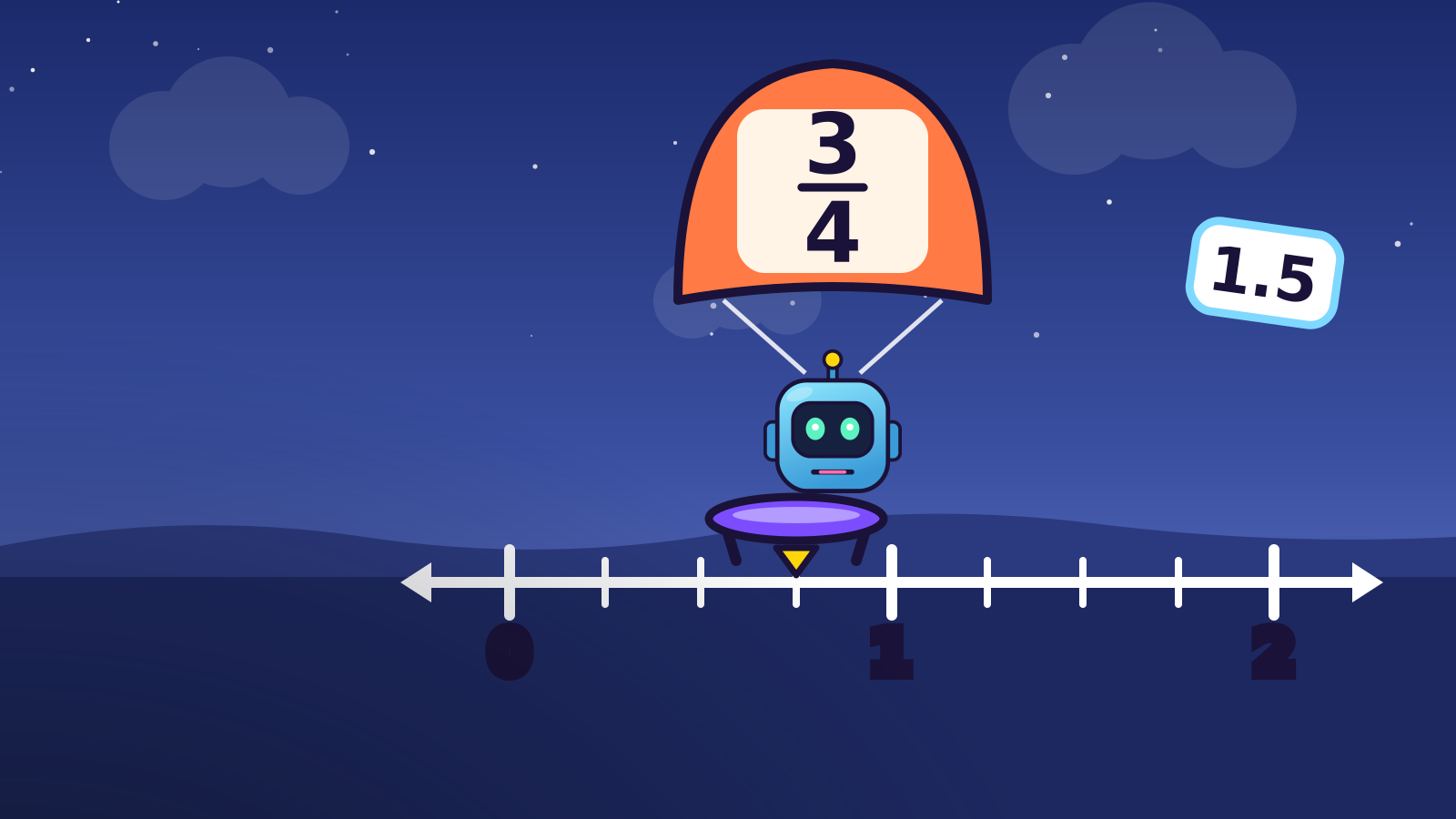
Number Line Bounce asks the same kind of question over and over with new numbers each time: a robot drops with a number like 3/4, and your child slides a trampoline to the tick where it belongs before it lands. Only the whole numbers are labelled, exactly as on this sheet. Ten minutes of the game the day after the worksheet is a good check of whether the counting idea stuck.
Standards
Common Core State Standards for Mathematics: CCSS 3.NF.A.2, CCSS 4.NF.B.3, CCSS 4.NF.C.6. These are the standards listed for the Number Line Bounce levels this sheet draws on.
Questions parents and teachers ask
What grade learns fractions on a number line?
In the Common Core standards, third graders learn to understand a fraction as a number on the number line and to show fractions on a number line diagram (3.NF.A.2). Fourth graders add mixed numbers (4.NF.B.3) and write tenths and hundredths as decimals (4.NF.C.6).
Point E could be 6/8 or 3/4. Which is right?
Both are right. 6/8 and 3/4 are equivalent fractions: they sit at the same point on the number line. Seeing that two fractions land on the same spot is how the standards introduce equivalence.
Why are only the whole numbers labelled?
Labelling every tick would give the answer away. With only 0, 1, 2 and 3 written, your child has to count the parts, which is the skill the sheet practices.
Does it print on A4 paper?
Yes. The pages fit the printable area of both US Letter and A4. Print at 100% (actual size) so the lines keep their equal spacing.
Keep exploring
Sources
Every fact on this page was checked against these sources by a separate fact-checker on November 3, 2026. How we check facts.