In short
Good fraction practice for grades 3 to 5 treats a fraction as a number with its own place on the number line, not just a slice of pizza, which is how the Common Core introduces fractions in grade 3 (3.NF.A.2). Number Line Bounce has kids place fractions, mixed numbers and decimals on a line, and Math-Man's Castle adds fifth-grade practice with a fraction of a whole number. Both are free in a web browser, with no account and no ads.
Key facts
- In the Common Core math standards, third graders learn to understand a fraction as a number on the number line (3.NF.A.2). Source: Common Core State Standards: Grade 3 Number and Operations—Fractions
- Grade 3 fractions use denominators 2, 3, 4, 6 and 8. Source: Common Core State Standards: Grade 3 Number and Operations—Fractions
- Fourth graders make equivalent fractions by multiplying the top and bottom numbers by the same number, and write tenths and hundredths as decimals. Source: Common Core State Standards: Grade 4 Number and Operations—Fractions
- Fifth graders add fractions with different denominators by first rewriting them with a common denominator (5.NF.A.1). Source: Common Core State Standards: Grade 5 Number and Operations—Fractions
- The fraction-of-a-number questions in Math-Man's Castle level 3, like 3/4 of 20, match the fifth-grade standard 5.NF.B.4.a. Source: Math-Man's Castle content file (fraction of a number, level 3)
In the Common Core math standards, fractions start in third grade and carry on through fifth, then lead into dividing fractions and negative numbers in sixth grade. Third graders learn that 1/4 is one part when a whole is cut into 4 equal parts, and that 3/4 is three of those parts. Fourth graders compare fractions, build equivalent fractions, add fractions with the same denominator and write tenths and hundredths as decimals. Fifth graders add fractions with different denominators and multiply fractions.
The games below cover the first half of that path: seeing where a fraction sits, which fractions are equal, how fractions greater than 1 work, and how decimals fit in. One level of Math-Man's Castle adds fifth-grade practice with a fraction of a whole number.
The games
Number Line Bounce · Grades 3–7
A robot falls with a number like 3/8 on its chute, and your kid slides the trampoline to the tick where it sits. Level 1 covers unit fractions, fractions like 3/5 and equivalent fractions on lines cut into smaller parts (grades 3–4); level 2 goes past 1 with fractions like 7/4, mixed numbers like 2 1/3, and decimals like 1.3 and 0.75 (grades 4–5).
Play level 1 of Number Line BounceMath-Man's Castle · Grades 3–8
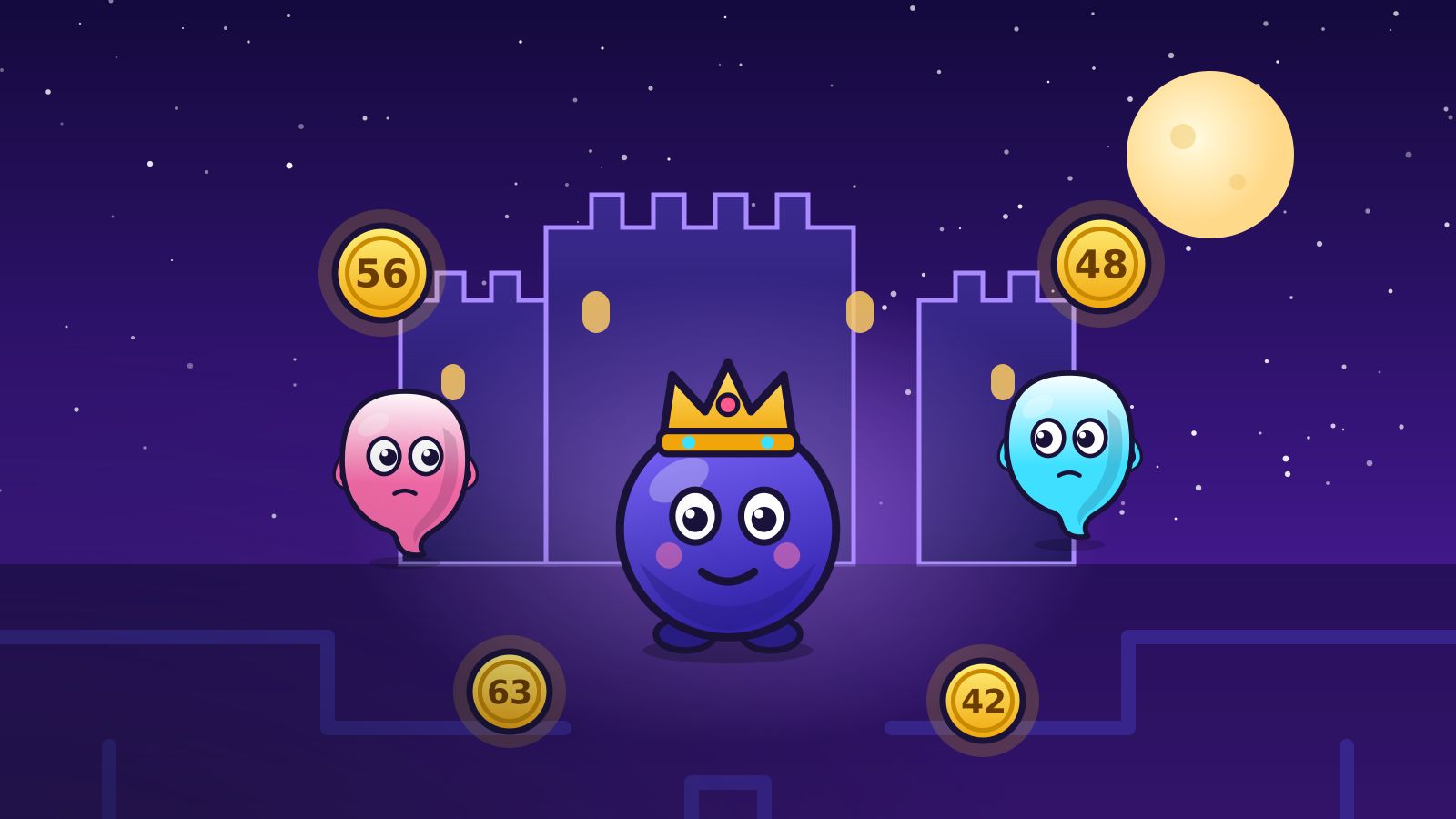
Every question on level 3 (grade 5) is a fraction of a whole number: about two in three are unit fractions like 1/4 of 28, and the rest are like 3/4 of 20. The four answers are coins in the corners of a dot maze, and Math-Man has to reach the right one while ghosts give chase. A wrong coin costs points, never a heart, and shows the full fact with a short tip. The quick method to teach alongside it: divide by the bottom number, then multiply by the top, so 20 ÷ 4 = 5 and 5 × 3 = 15.
Play level 3 of Math-Man's CastleType Rocket · Grades 3–8
Not a fraction game, but a useful side door: the words fraction and decimal (level 2) and denominator (level 3) come up as meteors to type, and each one shows its meaning once it is zapped.
Play level 2 of Type Rocket


Free printables
- Fractions on a number line worksheet (2 practice pages and a 1-page answer key, goes with Number Line Bounce)
- Winter math worksheets for grades 3 to 7 (3 practice pages, a 10-day plan and a 2-page answer key, goes with Times Table Dash)
What kids learn about fractions, grade by grade
Here is how the Common Core State Standards for Mathematics lay out fractions.
- Grade 3 (3.NF): a fraction 1/b is one part when a whole is cut into b equal parts, and a/b is a parts of that size. Students place fractions on a number line by cutting the space from 0 to 1 into equal parts. They learn that equal fractions sit at the same point, such as 1/2 = 2/4, that whole numbers can be written as fractions (3 = 3/1, and 4/4 is at the same point as 1), and they compare fractions with the same top or bottom number. Grade 3 sticks to denominators 2, 3, 4, 6 and 8.
- Grade 4 (4.NF): students make equivalent fractions by multiplying the top and bottom by the same number, compare fractions with different denominators, add and subtract fractions and mixed numbers with like denominators, multiply a fraction by a whole number, and write fractions with denominators 10 and 100 as decimals. Grade 4 uses denominators 2, 3, 4, 5, 6, 8, 10, 12 and 100.
- Grade 5 (5.NF): students add and subtract fractions with unlike denominators, see a fraction as division (a/b = a ÷ b), multiply fractions and mixed numbers, and divide unit fractions by whole numbers and whole numbers by unit fractions.
- Grade 6 (6.NS.A.1): students divide fractions by fractions.
Mix-ups to watch for
These are the fraction ideas that are easy to get backward. Each one comes with a quick check you can do together.
- A bigger bottom number means smaller pieces. 1/8 is less than 1/4, because the whole is cut into more parts. Ask: would you rather have 1/4 or 1/8 of a pizza?
- On a number line, count the spaces, not the tick marks. The line from 0 to 1 cut into 4 equal parts has only 3 ticks between 0 and 1, and 3/4 is at the end of the third space.
- Adding fractions does not mean adding the bottoms. 1/4 + 1/4 is 2/4, which is the same as 1/2, not 2/8. Two quarters of a cup of flour fill half a cup, not an eighth.
- Comparing only makes sense with the same whole. The standards say this outright: comparisons are valid only when the two fractions refer to the same whole. Half of a small pizza is not the same amount as half of a large one.
- A longer decimal is not always bigger. 0.25 is less than 0.5, because 0.5 is the same as 0.50, and 50 hundredths is more than 25 hundredths.
- A fraction can be more than 1. 7/4 is seven fourths, which is one whole (4/4) and 3/4 more, so 7/4 = 1 3/4.
Practice at home in five minutes
Our suggestion: keep fraction practice short and tied to things your kid can see or hold.
- Fold a paper strip. Write 0 at one end and 1 at the other, fold it in half, then in half again. The creases are 1/4, 2/4 and 3/4. Fold once more and the new creases are eighths, so 2/4 and 4/8 land on the same crease as 1/2.
- Use measuring cups. Ask how many 1/4 cups fill a 1/2 cup, or how many 1/3 cups make a whole cup. Then pour to check.
- Play one level of Number Line Bounce, then ask your kid to explain one robot they caught: how many parts was the line cut into, and how many did they count?
- For a fifth grader, ask a fraction-of question from daily life: there are 12 eggs and we used 3/4 of them, so how many did we use? Divide by 4, then multiply by 3.
Using these games in class
Every game plays in a browser on a classroom projector, with no student accounts. Number Line Bounce works well as a whole-class warm-up: put level 1 on the board, have students hold up fingers for how many parts they would count, then let one student slide the trampoline. A wrong landing shows a flag on the right tick and a short explanation, which gives you a natural moment to talk it through.
Our suggestion: use level 1 when you introduce fractions on a number line, level 2 when you get to mixed numbers and tenths, and the step-by-step guide at Fractions on a Number Line if students need a slower start.
Questions parents and teachers ask
Are these fraction games free?
Yes. They play in a web browser with no account, no download and no ads, on laptops, tablets, phones and classroom projectors.
Which grades are they for?
Mostly grades 3 to 5. Number Line Bounce level 1 matches third- and fourth-grade fraction standards and level 2 matches fourth and fifth grade. The fraction-of-a-number questions in Math-Man's Castle level 3, like 3/4 of 20, match the fifth-grade standard 5.NF.B.4.a: 3/4 × 20 means 3 parts of 20 split into 4 equal parts.
What grade learns equivalent fractions?
In the Common Core standards, third graders learn simple equivalent fractions such as 1/2 = 2/4 and 4/6 = 2/3, and fourth graders learn to make equivalent fractions by multiplying the top and bottom numbers by the same number.
When do kids add fractions with different denominators?
In fifth grade (5.NF.A.1), by first rewriting the fractions with a common denominator. In fourth grade they add and subtract fractions that already share a denominator, including mixed numbers.
My kid knows fractions as pizza slices. Why a number line?
Pizza slices show a fraction as part of a shape. The standards also ask third graders to see a fraction as a number on the number line, which is what later lets them compare fractions, see that 4/4 is the same as 1, and place decimals and negative numbers on the same line.
Keep exploring
Sources
Every fact on this page was checked against these sources by a separate fact-checker on November 3, 2026. How we check facts.
- Common Core State Standards: Grade 3 Number and Operations—Fractions
- Common Core State Standards: Grade 4 Number and Operations—Fractions
- Common Core State Standards: Grade 5 Number and Operations—Fractions
- Common Core State Standards: Grade 6 The Number System
- Number Line Bounce content file with each number rule and its source
- Math-Man's Castle content file (fraction of a number, level 3)
- Type Rocket content file (word list and meanings)