In short
Grammar games for grades 3 to 6 practice word-level grammar: choosing between sound-alike words like there, their and they're, synonyms and antonyms, prefixes, suffixes and roots, the parts of speech, and spelling. Word River covers the sound-alikes, synonyms and antonyms, and word parts, Slice of Speech the parts of speech, and Type Rocket spelling. None of them covers punctuation.
Key facts
- The Common Core lists to, too and two and there and their as examples of frequently confused words in fourth grade (L.4.1.G). Source: Common Core State Standards: Language, Grade 4
- Third graders explain what nouns, pronouns, verbs, adjectives and adverbs do (L.3.1.A). Source: Common Core State Standards: Language, Grade 3
- Fifth graders explain what conjunctions, prepositions and interjections do (L.5.1.A). Source: Common Core State Standards: Language, Grade 5
- Words that sound the same but have different meanings, like there, their and they're, are called homophones. Source: Cambridge Dictionary: homophone
- Sixth graders use Greek and Latin affixes and roots as clues to a word's meaning (L.6.4.B). Source: Common Core State Standards: Language, Grade 6
In the Common Core English language arts standards, the Language standards for grades 3 to 6 include grammar and usage (L.1), capital letters, punctuation and spelling (L.2), and vocabulary, including word parts and how words relate to each other (L.4 and L.5).
The games below practice the word-level parts of that list: commonly confused words like there, their and they're, synonyms and antonyms, prefixes, suffixes and Greek and Latin roots, the parts of speech, and spelling school words correctly. None of them covers punctuation or full-sentence editing.
The games
Word River · Grades 4–6
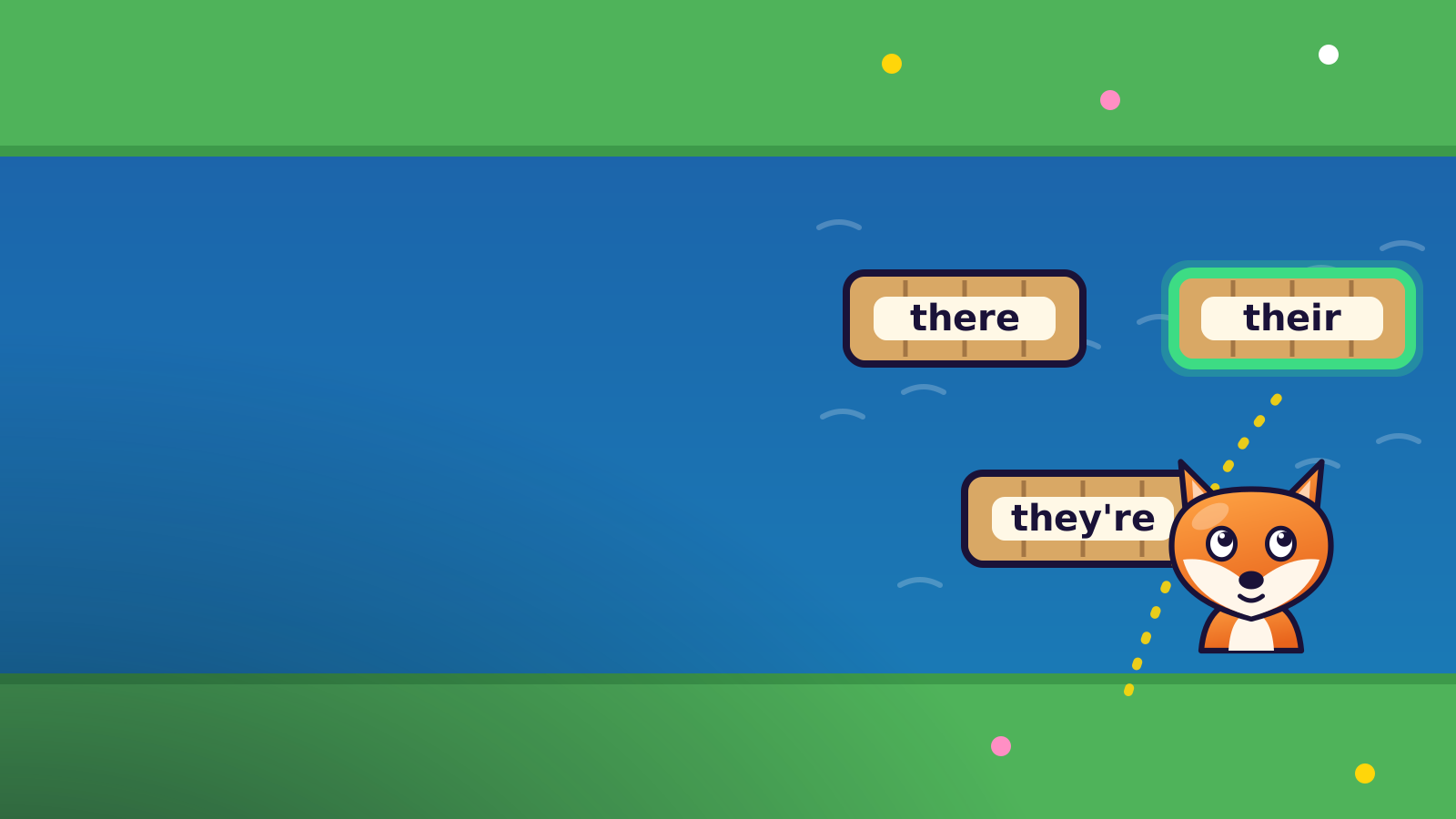
Hop onto the raft with the word that fits. Level 1 (grade 4) is sound-alike words in a sentence: there, their and they're; to, too and two; its and it's; your and you're; and pairs like hear and here. Level 2 (grades 4–5) is synonyms and antonyms, and level 3 (grades 5–6) is prefixes, suffixes and roots like re-, -less, tele- and port.
Play level 1 of Word RiverSlice of Speech · Grades 3–6
Each round names a part of speech and your kid slices every word card that is one. Level 1 is nouns, verbs and adjectives; level 2 is pronouns and adverbs; level 3 is prepositions, conjunctions and interjections (grades 3–6 across the three levels).
Play of Slice of SpeechType Rocket · Grades 3–8
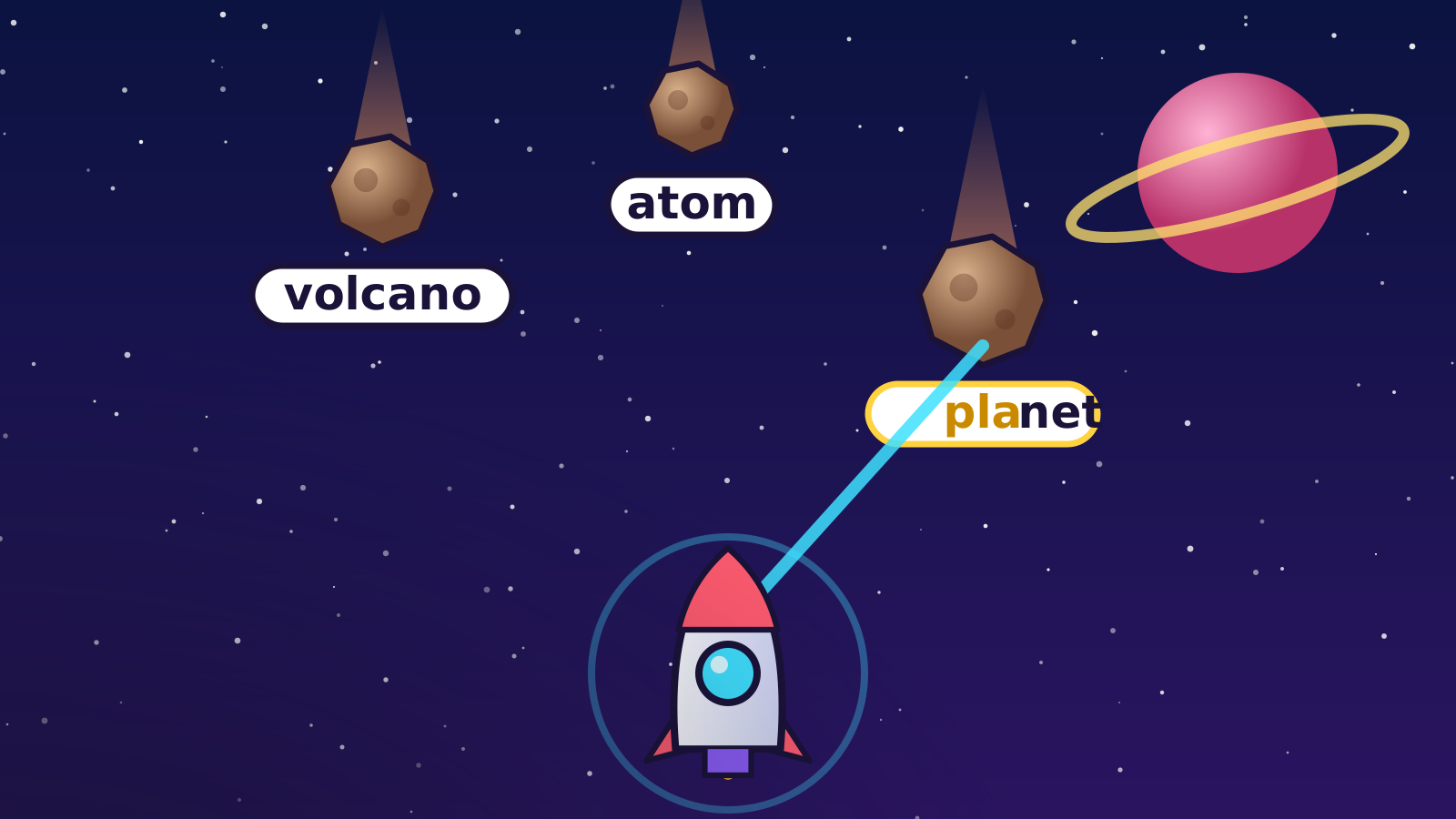
Type a word letter by letter to zap the meteor it is on, from short words like angle to long ones like circumference and parallelogram. A wrong letter breaks your streak, so it rewards getting the whole spelling right, and each word shows its meaning once it is zapped (grades 3–8).
Play of Type Rocket

Free printables
- Parts of speech worksheet: cut-and-sort cards (2 practice pages and a 1-page answer key, goes with Slice of Speech)
What grammar covers in grades 3 to 6
Here is a short tour of the Common Core Language standards, grade by grade, with the parts these games practice in mind.
- Grade 3 (L.3.1, L.3.2, L.3.4): explain what nouns, pronouns, verbs, adjectives and adverbs do; form regular and irregular plurals and verbs; use simple verb tenses; make subjects and verbs agree; spell words correctly when adding suffixes (sitting, smiled, cries, happiness); and work out a new word made by adding a known prefix or suffix to a known word.
- Grade 4 (L.4.1, L.4.4, L.4.5): use relative pronouns like who and which, order adjectives in the usual pattern (a small red bag, not a red small bag), correctly use frequently confused words such as to, too and two or there and their, use Greek and Latin affixes and roots as clues (telegraph, photograph, autograph), and understand words through their synonyms and antonyms.
- Grade 5 (L.5.1, L.5.4, L.5.5): explain what conjunctions, prepositions and interjections do, use perfect verb tenses, use pairs like either/or and neither/nor, use Greek and Latin prefixes, suffixes and roots, and use synonyms, antonyms and homographs to understand words.
- Grade 6 (L.6.1, L.6.2, L.6.4): use pronouns in the right case, including intensive pronouns like myself, spell correctly, and use Greek and Latin affixes and roots such as the aud in audience, auditory and audible.
Sound-alike words
Words like there, their and they're are called homophones: they sound the same but have different meanings, and often different spellings. The fourth-grade standard calls them frequently confused words. The quickest check is the contraction test: if you can say they are in its place, write they're. If you can say it is, write it's. If you can say you are, write you're. If not, use the other spelling: its or your, and for there and their, their shows something belongs to them and there is a place.
Word River builds each question as a sentence with a blank, so the meaning of the sentence decides the word, the same way it does when your kid writes.
Synonyms, antonyms and word parts
A synonym means the same or nearly the same as another word (begin and start), and an antonym means the opposite (begin and finish). Word River's wrong rafts are often near misses, such as old when the question asks for the opposite of ancient, so kids have to read the question, not just spot a related word.
Word parts are the fastest way to grow a vocabulary. Knowing a handful of them lets a kid work out words they have never seen:
- un- means not (unhappy), and in- can also mean not (invisible).
- re- means again (rebuild), and pre- means before (preview).
- -less means without (fearless), and -ful means full of (hopeful).
- tele- means far (telescope), micro- means small (microscope), and bio- means life (biology).
- port means carry (portable), and vis means see (visible).
Parts of speech, briefly
Third graders learn what nouns, pronouns, verbs, adjectives and adverbs do, and fifth graders add prepositions, conjunctions and interjections. Slice of Speech practices all eight, one level at a time. Our parts of speech games page has each one with a definition, examples and tips for spotting it in a sentence.
Practice at home and in class
- Our suggestion for home: pick one confused pair a week, like its and it's, and have your kid catch it in signs, menus and messages. Each time, ask them to do the contraction test out loud.
- Word part hunt: pick one prefix, like re- or un-, and list as many words with it as you can at dinner. Check each one: does the word still mean again or not?
- In class: every game plays on a projector with no student accounts. Word River level 1 works as a five-minute warm-up: read the sentence aloud, have students vote on a raft by holding up one, two or three fingers, then hop. A wrong raft shows the right word and why, which gives you the teaching moment.
Questions parents and teachers ask
Are these grammar games free?
Yes. They play in a web browser with no account, no download and no ads, on laptops, tablets, phones and classroom projectors.
Which grades are they for?
Mostly grades 3 to 6. Word River runs from grade 4 (sound-alike words) to grades 5–6 (word parts), Slice of Speech from grade 3 to grade 6, and Type Rocket's long-word level reaches grade 8.
What grade learns there, their and they're?
The Common Core standards list to, too and two and there and their as examples of frequently confused words in fourth grade (L.4.1.G).
Do the games teach punctuation?
No. They practice word choice, word meaning, parts of speech and spelling. Commas, quotation marks and capital letters are not part of any game yet.
What is the difference between grammar and parts of speech?
Parts of speech are one piece of grammar: the job each word does in a sentence. Grammar in the school standards also covers choosing the right word, verb tenses, agreement, spelling and word meanings.
Keep exploring
Sources
Every fact on this page was checked against these sources by a separate fact-checker on November 3, 2026. How we check facts.
- Common Core State Standards: Language, Grade 3
- Common Core State Standards: Language, Grade 4
- Common Core State Standards: Language, Grade 5
- Common Core State Standards: Language, Grade 6
- Cambridge Dictionary: homophone
- Word River content file with each item, its explanation and source
- Slice of Speech content file
- Type Rocket content file