These winter math worksheets are for the days between the end of school in December and the start of the new term: a little practice so the facts and skills from the fall stay fresh. Each of the first three pages is for a different grade band, so pick the one that fits your child, or print all three if you have kids in different grades. Page 4 is a ten-day plan with ten minutes of a math game each day. The last two pages are the answer key, with a short explanation for every problem that needs one.
Every problem follows the rules of one of our math games, and a separate fact-checker verified those rules. Snowflake facts (grades 3–4) is 24 multiplication facts from the 2 to 12 times tables, the facts in Times Table Dash levels 1 to 5, plus three snow-day word problems. Frozen pond (grades 4–5) has five fractions and decimals on number lines, from Number Line Bounce levels 1 and 2, and six bigger facts like 17 × 5 from Times Table Dash level 4. Below zero (grades 6–7) has four negative numbers on number lines and two questions on opposites and absolute value, from Number Line Bounce level 3, and eight equations from Balance Bridge levels 1 and 2.
Play the matching game
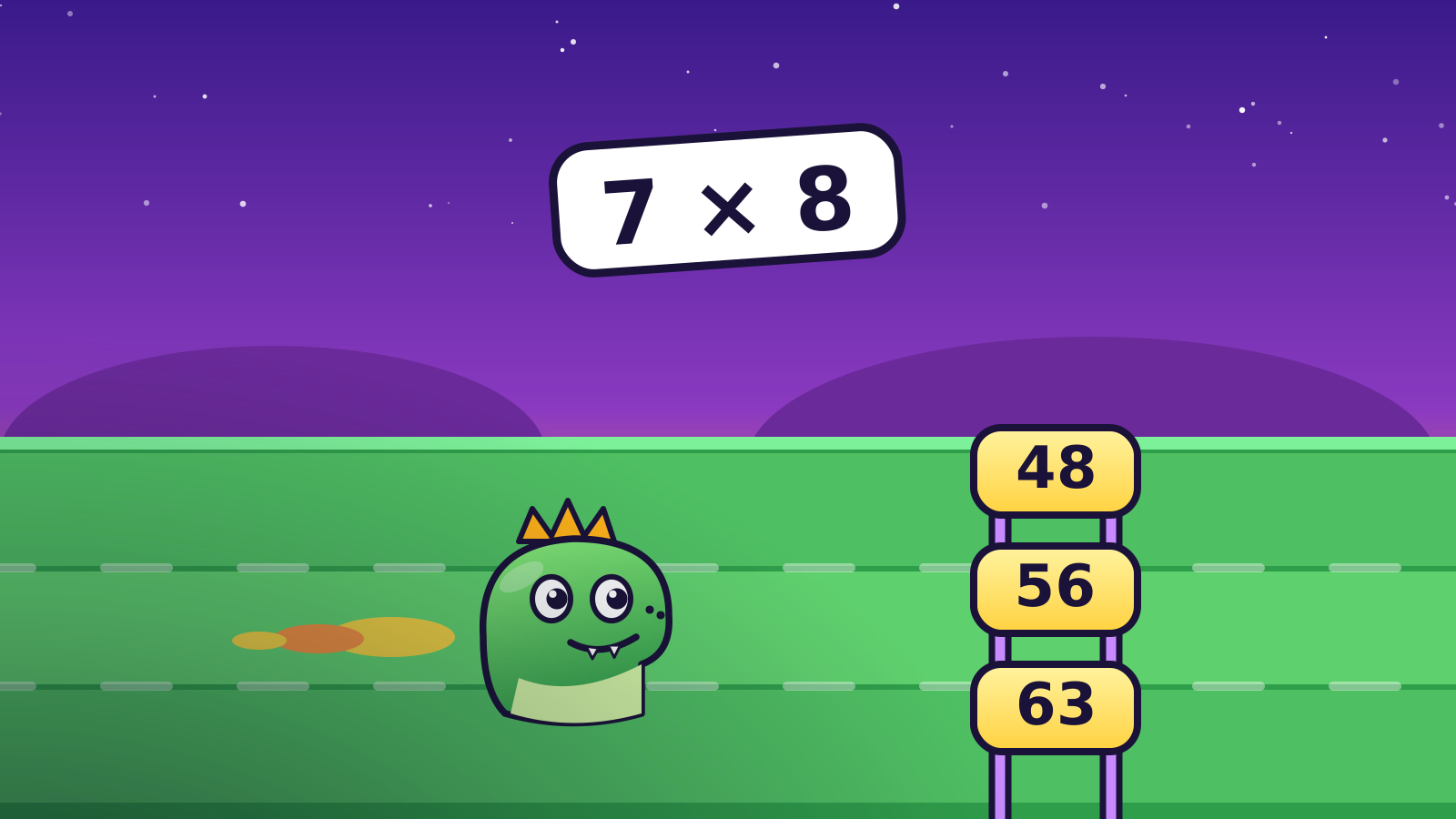
Times Table Dash practices the same times tables in a free browser game with no account and no ads.
Play Times Table DashThe sheet also follows Number Line Bounce and Balance Bridge.
Which page for which child
Use the grade your child is in now, then adjust. If the first few problems are slow or full of guesses, drop to the page below: a page your child can finish feels better than one they abandon. If the page is easy, move up. The three pages line up with the Common Core math standards:
- Snowflake facts: by the end of grade 3, students are expected to know from memory all products of two one-digit numbers (3.OA.C.7). The 11s and 12s go a little past that, as the game does.
- Frozen pond: third graders place fractions on a number line (3.NF.A.2), and fourth graders write tenths and hundredths as decimals (4.NF.C.6). Fourth graders also multiply a two-digit number by a one-digit number using place value (4.NBT.B.5), which is what the bigger facts practice.
- Below zero: sixth graders place negative numbers on a number line and find opposites and absolute value (6.NS.C.6 and 6.NS.C.7), and solve one-step equations like x + 7 = 15 and 4x = 36 (6.EE.B.7). Seventh graders solve two-step equations like 3x + 5 = 26 and 4(x + 3) = 36 (7.EE.B.4a).
The ten-minutes-a-day plan
Page 4 is a plan for ten days of the break, for example the weekdays. Day 1 is the worksheet page itself. Days 2 to 9 each name one level of a free Genius Arcade game, with a different column for each grade band. A level is short (5 to 10 right answers clear it), so play it again until about ten minutes are up. Day 10 is the same worksheet page again, done without looking at the first try, then checked with the key. Comparing the two tries shows your child what improved.
Ten minutes is our suggestion, not a rule. The point is that it's short enough to happen every day, even on a busy holiday week, and short enough to stop while it's still fun. Tick the box for each day that's done; a row of ticks by New Year's is a nice thing to show off.
Three of the games in the plan use the same rules as the sheet. In Times Table Dash, a ship flies through the gate with the right answer. In Number Line Bounce, a robot parachutes onto a number line, and your child slides a trampoline to the right tick. In Balance Bridge, an equation hangs in the two pans of a balance, and your child picks the weight for x that keeps it level. The plan also uses Answer Blaster, Math-Man's Castle and Shape Breaker.
How to help with each part
- Multiplication facts: have your child say the whole fact out loud ("seven eights are fifty-six"), not just the answer. For a fact they don't know, build it from one they do: 6 × 8 is 5 × 8 plus one more 8, so 40 + 8 = 48.
- Bigger facts: split off the ten. 17 × 5 is 10 × 5 plus 7 × 5, so 50 + 35 = 85. The sheet writes the split out with blanks to fill in.
- Number lines: count the spaces between tick marks, not the ticks. A line from 0 to 1 cut into eighths has 9 ticks but 8 parts. Find how many parts make each whole, then count parts from 0 to the dot.
- Below zero: the line works the same on both sides of 0. A dot 3 fourths to the left of 0 is −3/4. Opposites are the same distance from 0 on opposite sides, and absolute value is that distance.
- Equations: whatever you do to one side, do to the other, the way a balance stays level. Then check the answer by putting it back in: if x = 7 in 3x + 5 = 26, then 3 × 7 + 5 = 26.
Using the answer key
The answer key gives every answer, and an explanation for each number line, word problem and equation. If your child got one wrong, read the explanation together rather than just marking it, and then try a similar problem out loud. A wrong answer that gets talked through teaches more than a page of right ones.
The key prints on its own two pages, so you can keep it back while your child works.
Standards
Common Core State Standards for Mathematics: CCSS 3.OA.C.7, CCSS 4.NBT.B.5, CCSS 5.NBT.B.5, CCSS 3.NF.A.2, CCSS 4.NF.B.3, CCSS 4.NF.C.6, CCSS 6.NS.C.6, CCSS 6.EE.B.7, CCSS 7.EE.B.4a. These are the standards listed for the Times Table Dash and Number Line Bounce and Balance Bridge levels this sheet draws on.
Questions parents and teachers ask
What grades are these winter math worksheets for?
Grades 3 to 7, in three bands: Snowflake facts for grades 3 and 4, Frozen pond for grades 4 and 5, and Below zero for grades 6 and 7. Print the page that fits your child, or all three.
Do the games in the plan need an account?
No. Right now every game in the plan plays free in a web browser with no account, no download and no ads, on a laptop, tablet or classroom projector.
Can teachers use these before the winter break?
Yes. Print the page for your grade as a last-week review, and send the ten-day plan home with it. The games need no student accounts, so families can follow the plan without signing anything up.
Does it print on A4 paper?
Yes. The pages fit the printable area of both US Letter and A4. Print at 100% (actual size) so the number lines keep their equal spacing.
Keep exploring
- Times Table Dash
- Number Line Bounce
- Balance Bridge
- Printable multiplication chart with blanks (1–12)
- Fractions on a number line worksheet
- Multiplication games for times tables practice
- Fractions on a number line: a game that makes them land
- Solving equations: a game where the answer has to balance
- Math games for grades 3 to 9
- All free printables
Sources
Every fact on this page was checked against these sources by a separate fact-checker on November 4, 2026. How we check facts.
- Common Core State Standards: Grade 3 Operations and Algebraic Thinking
- Common Core State Standards: Grade 4 Number and Operations in Base Ten (4.NBT.B.5)
- Common Core State Standards: Grade 3 Number and Operations—Fractions
- Common Core State Standards: Grade 4 Number and Operations—Fractions
- Common Core State Standards: Grade 6 The Number System
- Common Core State Standards: Grade 6 Expressions and Equations
- Common Core State Standards: Grade 7 Expressions and Equations
- Times Table Dash content file: each times table and its tip
- Number Line Bounce content file: each number rule and its explanation
- Balance Bridge content file: each equation rule and its explanation