This sheet is for a child who is learning the times tables from 1 to 12 and is ready to work some of them out instead of just looking them up. Page 1 is a multiplication chart where the 1s, 2s, 5s and 10s rows and columns are already filled in. Those are the facts most kids learn first, and they become the stepping stones for everything else. Your child fills in the blank squares. Page 2 has 16 problems that show how to build a harder fact out of easier ones, such as 7 × 8 as 5 × 8 plus 2 × 8. The last page is the answer key: the complete chart and every strategy step.
Third grade is where this happens in the Common Core math standards: by the end of grade 3, students are expected to know from memory all products of two one-digit numbers (3.OA.C.7). The same standards ask grade 3 students to use properties of operations, like splitting a number into parts, as strategies to multiply (3.OA.B.5). That second standard is exactly what page 2 practices.
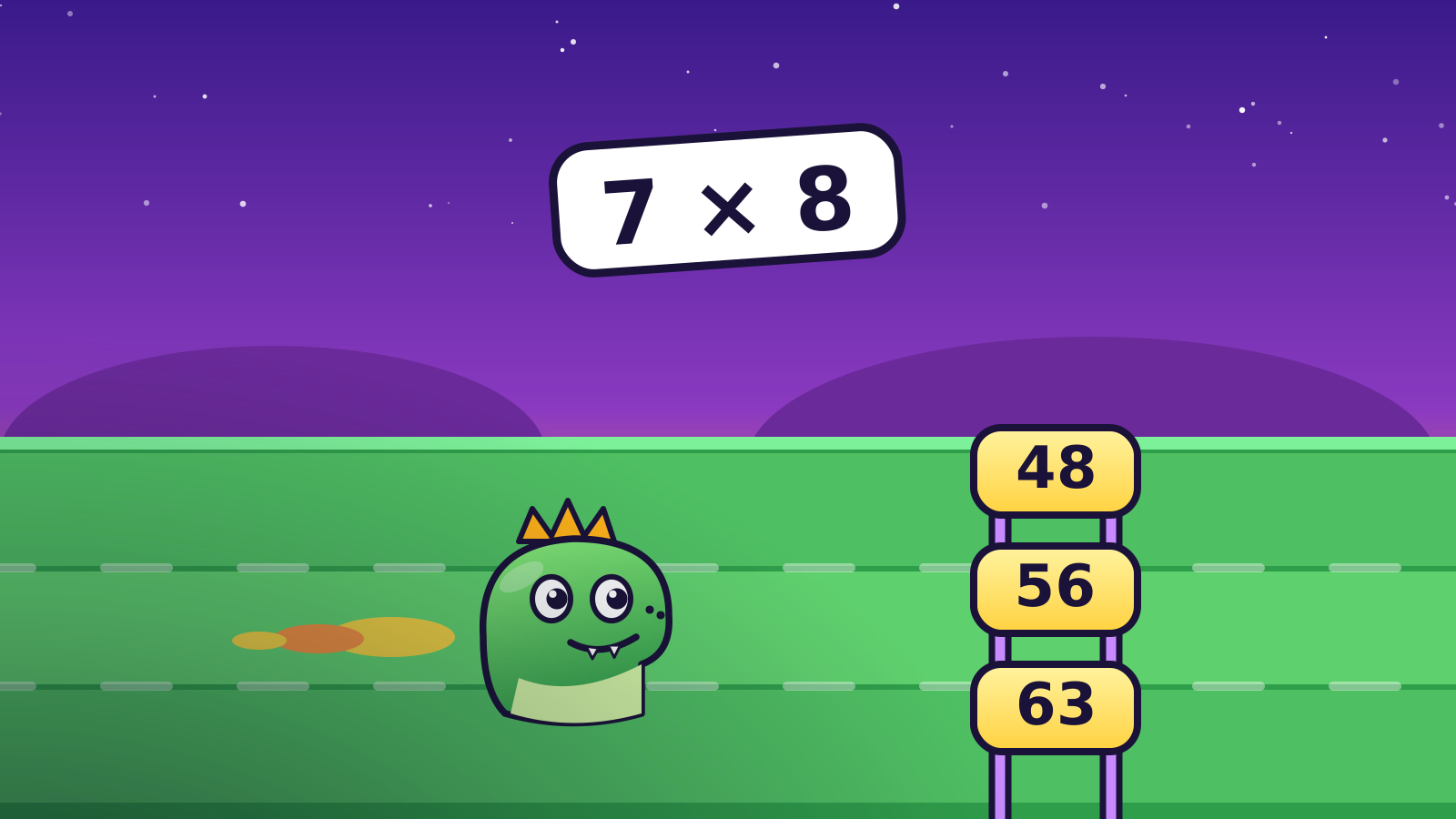
Play the matching game
Times Table Dash practices the same times tables in a free browser game with no account and no ads.
Play Times Table DashHow to use the chart
Don't ask for the whole chart in one sitting. A blank 12 × 12 chart has 144 squares, and even with the easy rows filled in there are 64 blank squares left. That's a lot of writing for a 9-year-old, and the last rows get rushed. Spread it over a week instead:
- Day 1: the 3s and 4s rows. For each blank, look left to the row number and up to the column number.
- Day 2: the 6s row and the 6s column.
- Day 3: the 7s and 8s rows.
- Day 4: the 9s, 11s and 12s rows.
- Day 5: check the whole chart against the answer key, and circle every square that was wrong or slow.
Before you start, point out that the chart is symmetrical: the 3s row and the 3s column hold the same numbers, because 3 × 7 and 7 × 3 are both 21. Once your child has filled in a row, they can copy it into the matching column. That halves the work and teaches the turnaround idea at the same time.
How to use the strategy page
Each problem on page 2 gives the steps and leaves blanks for the numbers. 9 × 6 is written as 10 × 6 minus 6, with a blank for 10 × 6 and a blank for the answer. Your child only needs facts they already know (the 10s, 5s, 2s and doubling) to fill it in. The strategies are the same ones the Times Table Dash game shows after a wrong answer, so a child who plays the game will recognize them.
Ask your child to say each step out loud the first time: 'Ten sixes is sixty, take away one six, fifty-four.' Talking it through helps them notice which step went wrong when an answer doesn't match the key.
Checking the answers
Let your child mark their own sheet with the answer key, using a different color. Self-checking turns a mistake into information: a child who gets 7 × 8 wrong twice now knows it is a fact to practice, not just a red mark from someone else.
Then make a short list of the circled facts. Those are the ones worth a few minutes of practice each day until they come quickly. In Times Table Dash, each game also ends with up to three facts to practice, so the sheet and the game point at the same gaps.
Using it in class
Teachers can print one chart per student and use it as a warm-up over several days, a row or two at a time. The strategy page works as a short whole-class discussion: put one problem on the board and ask students to explain each step before anyone writes a number. The game plays on a classroom projector with no student accounts, so a round of Times Table Dash makes a quick follow-up for the same tables.
Standards
Common Core State Standards for Mathematics: CCSS 3.OA.C.7, CCSS 4.NBT.B.5, CCSS 5.NBT.B.5. These are the standards listed for the Times Table Dash levels this sheet draws on.
Questions parents and teachers ask
What grade learns the multiplication table?
In the Common Core math standards, students are expected to know all products of two one-digit numbers from memory by the end of grade 3 (3.OA.C.7).
Why are some rows already filled in?
The 1s, 2s, 5s and 10s are the facts most children learn first, and the strategy page uses them to work out harder facts. Filling them in leaves 64 blank squares to practice.
Will it print on A4 paper?
Yes. The sheet is sized to fit inside the printable area of both US Letter and A4 paper. Choose your paper size in the print dialog and print at 100% (actual size).
Is there a game that goes with it?
Yes, Times Table Dash practices the same tables, from the 2s through the 12s (the 11s and 12s in levels 4 and 5), in a free browser game with no account and no ads. A wrong answer shows the right one with a tip like the ones on page 2.
Keep exploring
Sources
Every fact on this page was checked against these sources by a separate fact-checker on November 3, 2026. How we check facts.