This is a one-page worksheet on the three branches of the U.S. federal government. The top of the page names each branch and what it is called: Congress is the legislative branch, the President leads the executive branch, and the federal courts are the judicial branch. Below that are 21 powers and facts about the branches, from the Constitution and USA.gov, in mixed order. Your child writes C, P or J next to each one, for Congress, President or Courts (judicial). The answer key explains every answer in one sentence.
Every item comes from Level 1 of Civics Pop, our civics bubble-shooter game. Each was checked against the text of the Constitution at the National Archives or against USA.gov's page on the branches of government. Items were picked so that each fits exactly one branch, with no reasonable teacher marking it another way.
Play the matching game
Civics Pop practices the same civics in a free browser game with no account and no ads.
Play Civics PopA quick way to explain the branches
Before the sheet, try a short version your child can remember: Congress makes the laws, the President carries them out, and the courts decide what the laws mean. Nearly every item on the sheet is one of those three jobs, or a power that helps a branch do its job or check another branch.
Then ask why the Constitution split the power three ways at all. Several items on the sheet are checks: the President can veto a bill, Congress can pass it over the veto with a two-thirds vote, and the courts can decide a law goes against the Constitution. Spotting those three makes a good discussion after the sheet is done.
Items that cause mix-ups
- Treaties and Supreme Court justices: the President makes treaties and chooses justices, but the Senate has to agree. The worksheet sorts them under President, because the President is the one who acts; the Senate approves.
- Impeachment: it belongs to Congress, not the courts, even though there is a trial. The House impeaches (charges) and the Senate holds the trial.
- Declaring war: children often guess the President, because the President is commander in chief. The Constitution gives the power to declare war to Congress.
- 'During good behavior': this old phrase from the Constitution means federal judges have no set term. They can serve for life unless they retire or are impeached and removed.
Using it in class
The sheet works as a 15-minute lesson. Spend 3 minutes on the three-branch summary at the top, 7 minutes on the sort (alone or in pairs), and 5 minutes going over the items students disagreed on, with the answer key. To extend it, ask each pair to pick one power and explain how it lets one branch check another.
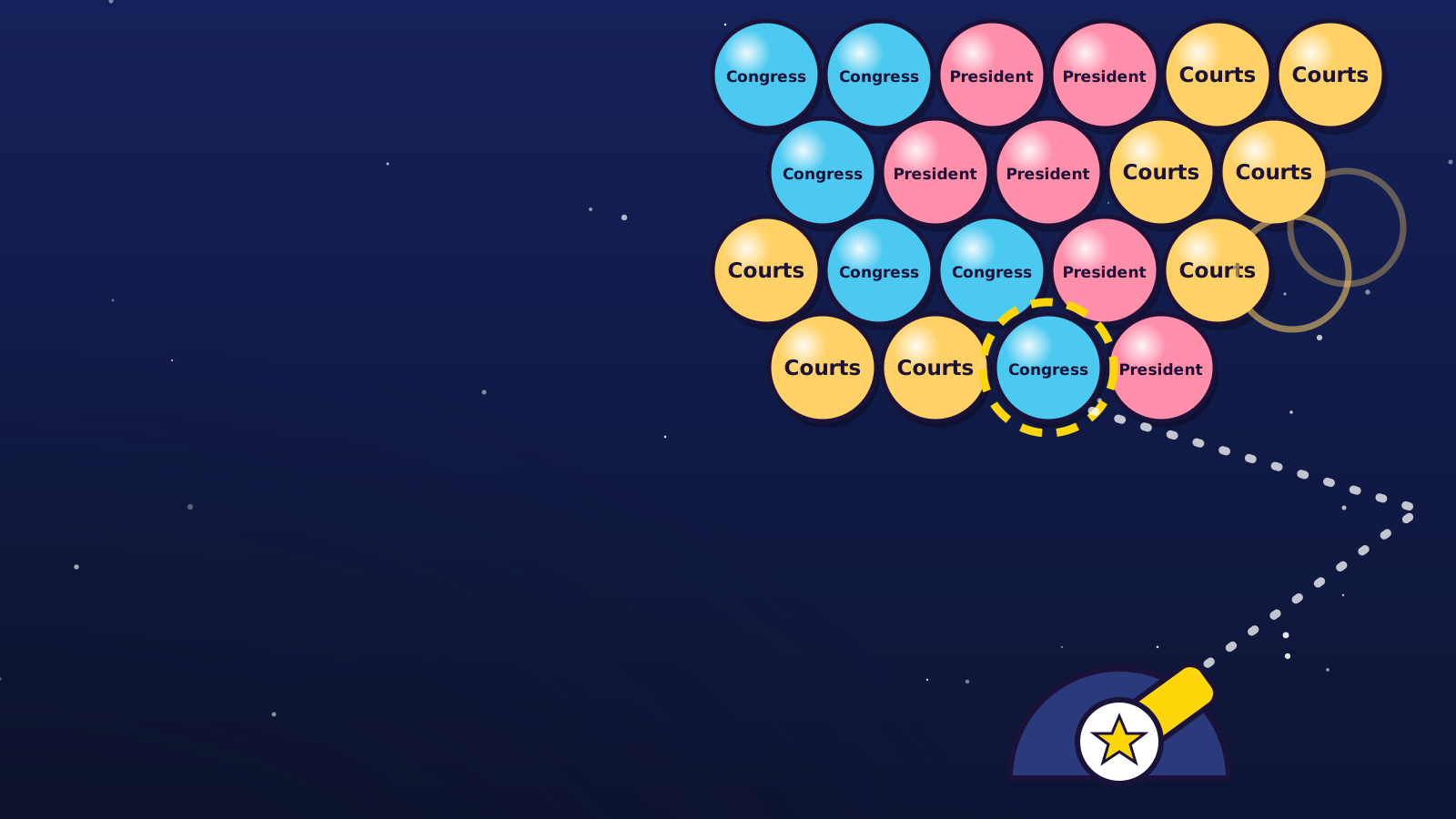
Civics Pop plays on a classroom projector with no student accounts. In Level 1, a prompt such as 'Can declare war' appears, and the player shoots it into the bubbles of the right branch. Levels 2 and 3 go further, into the Senate and the House and then the Bill of Rights, for grades 6–8.
At home
If your child is studying the branches for a test, do the sheet once, check it with the key, and then have them teach it back to you, using only the three-branch summary as notes. Explaining it to someone else shows quickly which items they really understand.
Standards
C3 Framework for Social Studies State Standards: C3 D2.Civ.4.6-8. These are the standards listed for the Civics Pop levels this sheet draws on.
Questions parents and teachers ask
What are the three branches of government?
The legislative branch (Congress) makes the laws, the executive branch (led by the President) carries out the laws, and the judicial branch (the federal courts, including the Supreme Court) decides what the laws mean.
Why are treaties under President if the Senate has to agree?
The President makes treaties, and two-thirds of the senators present must agree to them. The worksheet sorts the power under the branch that acts, and the answer key mentions the Senate's role.
What grade learns the three branches of government?
Civics Pop pitches the three branches at grades 4–5. In the C3 Framework for social studies, explaining the powers and limits of the three branches is a grades 6–8 expectation (D2.Civ.4.6-8), so this sheet prepares for it.
Does it print on A4 paper?
Yes. The worksheet fits the printable area of both US Letter and A4 paper. Print at 100% (actual size).
Keep exploring
Sources
Every fact on this page was checked against these sources by a separate fact-checker on November 3, 2026. How we check facts.