This periodic table worksheet covers the first 20 elements, from hydrogen to calcium. Page 1 is a small periodic table with one blank in every square: the atomic number, the symbol or the name. Your child fills in the blanks, then shades the squares of the metals. Page 2 has three short parts: atomic numbers and protons, nine symbols that come from older names, and metal or nonmetal. Page 3 is the answer key, with the completed table, every answer on page 2, and a one-line explanation for each answer in Parts A and B.
Every name, symbol, atomic number and metal or nonmetal label comes from the element table in Element Dash, which was taken from PubChem's periodic table and checked by a separate fact-check before the game went live. In Element Dash the player steers an owl into the gate with the right answer, and its levels 2, 3 and 4 practice the same facts as this sheet.
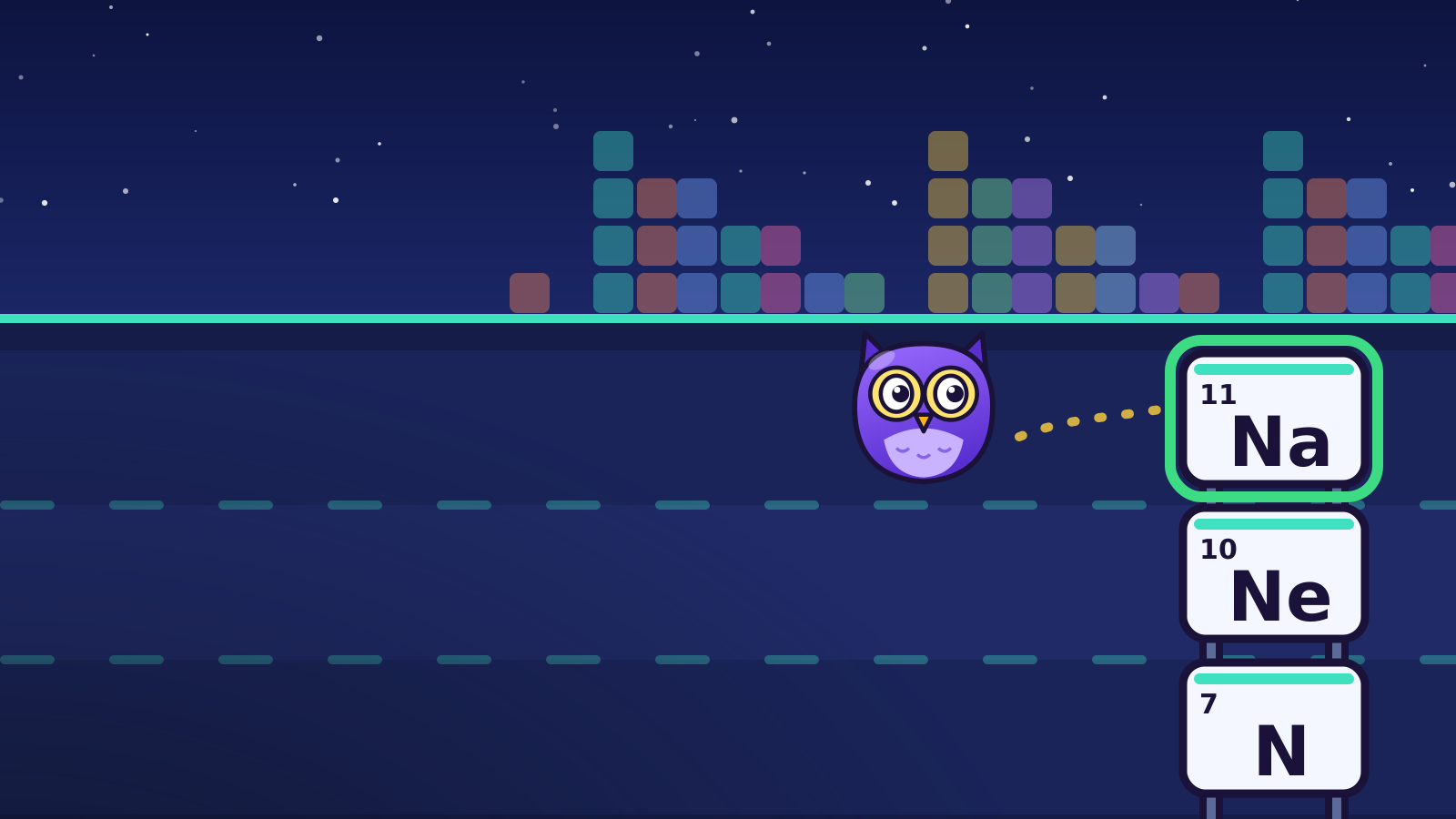
Play the matching game
Element Dash practices the same periodic table in a free browser game with no account and no ads.
Play Element DashHow to read one square of the periodic table
Each square on the sheet shows three things about one element:
- The atomic number, at the top. It is the number of protons in every atom of that element: every carbon atom has 6 protons.
- The symbol, in big letters. It has one or two letters. The first is a capital, and a second letter is lowercase, so magnesium is Mg, not MG.
- The name. The sheet uses the U.S. spellings PubChem gives, such as aluminum and sulfur.
Many printed periodic tables also show each element's atomic mass. This sheet leaves it out to keep the squares simple.
Why the table has rows and columns
The elements go in order of atomic number, left to right and row by row. Hydrogen is 1 and helium is 2, then lithium starts the next row at 3. Each row is called a period. Each column is called a group, and the elements in the same column are a family with similar chemical properties. That is why the periodic table is a table and not a simple list.
Two things on page 1 often puzzle children. Hydrogen sits at the top of the first column, but it is a nonmetal, not a metal like lithium and sodium below it. And there is a gap after the second column: columns 3 to 12 only start in row 4, after calcium. This sheet stops at calcium, element 20, so that gap stays empty.
Symbols that don't match the name
Most symbols start like the element's English name: O for oxygen, C for carbon, Ca for calcium. Nine common ones come from older names instead, most of them Latin. Only copper's Cu starts with the same letter as the English name, and even there the u comes from the Latin cuprum:
- Na, sodium: from the Latin natrium.
- K, potassium: from the Latin kalium.
- Fe, iron: from the Latin ferrum.
- Cu, copper: from the Latin cuprum.
- Ag, silver: from the Latin argentum.
- Sn, tin: from the Latin stannum.
- Au, gold: from the Latin aurum.
- Hg, mercury: from hydrargyrum, meaning “liquid silver”.
- Pb, lead: from the Latin plumbum.
Part B of page 2 asks for all nine, with a word bank. In Element Dash the wrong gates for these symbols are look-alikes, such as nitrogen and sulfur for Na, or silicon and argon for Ag, so guessing from the first letter doesn't work there.
Metals, nonmetals and metalloids
Metals like iron, copper and gold are shiny and let heat and electricity through easily. Nonmetals like oxygen and sulfur don't. Of the first 20 elements, 7 are metals: lithium, beryllium, sodium, magnesium, aluminum, potassium and calcium. Boron and silicon are metalloids, and the other 11 are nonmetals.
Page 1 tells your child that elements 5 and 14 are metalloids, so they know to leave those two unshaded. Part C on page 2 then mixes metals and nonmetals, including four metals from beyond the first 20: iron, copper, gold and tin.
A 10-minute routine
- Minutes 1–4: fill in page 1 without help, then check any square you weren't sure of.
- Minutes 5–7: page 2, Parts A to C.
- Minutes 8–10: play Element Dash. Level 3 (the first 20 elements) matches page 1, and level 4 (atomic numbers and old symbols) matches Parts A and B.
Print the sheet again a week later and see how many blanks your child can fill in from memory.
In the classroom
Teachers can use page 1 as a warm-up at the start of a periodic table unit and page 2 as an exit ticket. Element Dash plays on a classroom projector with no student accounts, so a whole class can call out which gate the owl should fly through.
Standards
Next Generation Science Standards: NGSS MS-PS1-1, NGSS HS-PS1-1. These are the standards listed for the Element Dash levels this sheet draws on.
Questions parents and teachers ask
What is an atomic number?
The number of protons in every atom of an element. Hydrogen's atomic number is 1, so every hydrogen atom has 1 proton; calcium's is 20. The periodic table puts the elements in order of atomic number.
Why is sodium's symbol Na?
It comes from natrium, sodium's Latin name. Potassium (K, kalium), iron (Fe, ferrum), copper (Cu, cuprum), silver (Ag, argentum), tin (Sn, stannum), gold (Au, aurum) and lead (Pb, plumbum) work the same way, and mercury's Hg comes from hydrargyrum, meaning “liquid silver”.
What grade is this periodic table worksheet for?
Grades 6 to 8. Page 1 and Part C match Element Dash's levels for grades 6 and 7. Parts A and B match its level 4, pitched at grades 8 to 10, so younger children may need help with those two parts.
Does it print on A4 paper?
Yes. Every page fits the printable area of both US Letter and A4 paper. Print at 100% (actual size).
Keep exploring
Sources
Every fact on this page was checked against these sources by a separate fact-checker on November 4, 2026. How we check facts.
- PubChem (National Library of Medicine): Periodic Table of Elements
- PubChem: element pages, History section, for the symbol origins (sodium shown; the others are at /element/<name>)
- OpenStax Chemistry 2e on LibreTexts: Appendix A, The Periodic Table (groups, periods, metals, metalloids and nonmetals)
- OpenStax Chemistry 2e on LibreTexts: 2.3 Atomic Structure and Symbolism (the atomic number is the number of protons)
- OpenStax Chemistry 2e on LibreTexts: 2.5 The Periodic Table (periods, groups with similar chemical properties, metals and nonmetals)
- NGSS: MS-PS1-1 Matter and its Interactions
- NGSS: HS-PS1-1 Matter and its Interactions
- Element Dash content file: the element table and every item's source